Warning! Do not watch this video if you have a tender heart. The brutal indifference of ordinary Chinese in Guangdong shown toward a badly injured 2 year old girl is almost unbelievable. And China considers itself the civilised society!
(h/t Mish)
Two year old YueYue died in the hospital after a week in coma. She died of progressive organ failure.
The media is claiming that the little girl's injury, neglect, and subsequent death raises painful questions in China about the value of human life in the Celestial Kingdom. The media is also saying that "it was too dark to see" the little girl, lying crushed and bleeding in the middle of the road.
But let's be honest about this tragic incident. The original van driver may not have seen the little girl before knocking her down. But after that, he knew he had hit something or someone -- and never bothered to look! After that, the events unfolded as if in a zombie movie -- except without the flesh-eating.
The video speaks for itself.
In the Al Fin blogs, we have commented at length on the alienating nature of Chinese society, particularly its one-child policy which leaves individuals with no siblings, no uncles or aunts, no cousins, no extended family or sense of belonging. In this case, if YueYue was an only child, the line stops there.
Friday, October 21, 2011

Ray Kurzweil vs. Paul Allen: Is the Singularity Near?
When will humanity reach Singularity, that now-famous point in time when artificial intelligence becomes greater than human intelligence? It is aptly called the Singularity proponents like Ray Kurzweil: like the singularity at the center of a black hole, we have no idea what happens once we reach it. However, the debate today is not what happens after the Singularity, but when will it happen. _BigThinkIn the video below, Kurzweil discusses some of his ideas about the coming singularity, including timelines and cautionary notes.
Microsoft co-founder and billionaire Paul Allen recently expressed skepticism about Kurzweil's timeline for the singularity, in a Technology Review article.
Futurists like Vernor Vinge and Ray Kurzweil have argued that the world is rapidly approaching a tipping point, where the accelerating pace of smarter and smarter machines will soon outrun all human capabilities. They call this tipping point the singularity, because they believe it is impossible to predict how the human future might unfold after this point. Once these machines exist, Kurzweil and Vinge claim, they'll possess a superhuman intelligence that is so incomprehensible to us that we cannot even rationally guess how our life experiences would be altered. Vinge asks us to ponder the role of humans in a world where machines are as much smarter than us as we are smarter than our pet dogs and cats. Kurzweil, who is a bit more optimistic, envisions a future in which developments in medical nanotechnology will allow us to download a copy of our individual brains into these superhuman machines, leave our bodies behind, and, in a sense, live forever. It's heady stuff.Allen goes on to discuss the "complexity brake," which the limitations of the human brain (and the limitations of the human understanding of the human brain) will apply to any endeavour that begins to accelerate in complexity too quickly.
While we suppose this kind of singularity might one day occur, we don't think it is near.
...Kurzweil's reasoning rests on the Law of Accelerating Returns and its siblings, but these are not physical laws. They are assertions about how past rates of scientific and technical progress can predict the future rate. Therefore, like other attempts to forecast the future from the past, these "laws" will work until they don't. More problematically for the singularity, these kinds of extrapolations derive much of their overall exponential shape from supposing that there will be a constant supply of increasingly more powerful computing capabilities. For the Law to apply and the singularity to occur circa 2045, the advances in capability have to occur not only in a computer's hardware technologies (memory, processing power, bus speed, etc.) but also in the software we create to run on these more capable computers. To achieve the singularity, it isn't enough to just run today's software faster. We would also need to build smarter and more capable software programs. Creating this kind of advanced software requires a prior scientific understanding of the foundations of human cognition, and we are just scraping the surface of this. _Technology Review_Paul Allen
Allen's argument is remarkably similar to arguments previously put forward by Al Fin neurscientists and cognitivists. The actual way that the human brain works, is something that is very poorly understood -- even by the best neuroscientists and cognitivists. If that is true, the understanding of the brain by artificial intelligence researchers tends to be orders of magnitude poorer. If these are the people who are supposed to come up with super-human intelligence and the "uploading of human brains" technology that posthuman wannabes are counting on, good luck!
But now, Ray Kurzweil has chosen the same forum to respond to Paul Allen's objections:
Allen writes that "the Law of Accelerating Returns (LOAR). . . is not a physical law." I would point out that most scientific laws are not physical laws, but result from the emergent properties of a large number of events at a finer level. A classical example is the laws of thermodynamics (LOT). If you look at the mathematics underlying the LOT, they model each particle as following a random walk. So by definition, we cannot predict where any particular particle will be at any future time. Yet the overall properties of the gas are highly predictable to a high degree of precision according to the laws of thermodynamics. So it is with the law of accelerating returns. Each technology project and contributor is unpredictable, yet the overall trajectory as quantified by basic measures of price-performance and capacity nonetheless follow remarkably predictable paths.Kurzweil's attitude seems to be: "Because difficult problems have arisen and been solved in the past, we can expect that all difficult problems that arise in the future will also be solved." Perhaps I am being unfair to Kurzweil here, but his reasoning appears to be fallacious in a rather facile manner.
...Allen writes that "these 'laws' work until they don't." Here, Allen is confusing paradigms with the ongoing trajectory of a basic area of information technology. If we were examining the trend of creating ever-smaller vacuum tubes, the paradigm for improving computation in the 1950s, it's true that this specific trend continued until it didn't. But as the end of this particular paradigm became clear, research pressure grew for the next paradigm.
...Allen's statement that every structure and neural circuit is unique is simply impossible. That would mean that the design of the brain would require hundreds of trillions of bytes of information. Yet the design of the brain (like the rest of the body) is contained in the genome. And while the translation of the genome into a brain is not straightforward, the brain cannot have more design information than the genome. Note that epigenetic information (such as the peptides controlling gene expression) do not appreciably add to the amount of information in the genome. Experience and learning do add significantly to the amount of information, but the same can be said of AI systems.
...How do we get on the order of 100 trillion connections in the brain from only tens of millions of bytes of design information? Obviously, the answer is through redundancy. There are on the order of a billion pattern-recognition mechanisms in the cortex. They are interconnected in intricate ways, but even in the connections there is massive redundancy. The cerebellum also has billions of repeated patterns of neurons.
...Allen mischaracterizes my proposal to learn about the brain from scanning the brain to understand its fine structure. It is not my proposal to simulate an entire brain "bottom up" without understanding the information processing functions. We do need to understand in detail how individual types of neurons work, and then gather information about how functional modules are connected. The functional methods that are derived from this type of analysis can then guide the development of intelligent systems. Basically, we are looking for biologically inspired methods that can accelerate work in AI, much of which has progressed without significant insight as to how the brain performs similar functions. _TechnologyReview_Ray Kurzweil
Al Fin neuroscientists and cognitivists warn Kurzweil and other singularity enthusiasts not to confuse the cerebellum with the cerebrum, in terms of complexity. They further warn Kurzweil not to assume that a machine intelligence researcher can simply program a machine to emulate neurons and neuronal networks to a certain level of fidelity, and then vastly expand that model to the point that it achieves human-level intelligence. That is a dead end trap, which will end up wasting many billions of dollars of research funds in North America, Europe, and elsewhere to discover.
This debate has barely entered its opening phase. Paul Allen is ahead in terms of a realistic appraisal of the difficulties ahead. Ray Kurzweil scores points based upon his endless optimism and his proven record of skillful reductionist analyses and solutions of previous problems.
Simply put, the singularity is not nearly as near as Mr. Kurzweil predicts. But the problem should not be considered impossible. Clearly, we will need a much smarter breed of human before we can see our way clear to the singularity. As smart as Mr. Kurzweil is, and as rich as Mr. Allen is, we are going to need something more from whatever humans who eventually birth the singularity.
Originally written for Al Fin, the Next Level
Thursday, October 20, 2011
The Hollow Paper Tiger That is Russia's Military
Russia's severe and growing shortage of 18 year old men fit for military conscription is sending repercussions throughout the corrupt and corroding infrastructure of Russian defense forces. When a nation's military is as unpopular with its own people as the Russian military, its credibility as a viable defense diminishes. As this process continues to its seemingly inevitable conclusion, the bulk of Eastern Siberia becomes less and less likely to remain in Russian hands for many more decades.
But the way things are going, the number of military age men in Russia of sound mind, body, and character -- and who are also ethnic Russians -- are shrinking rapidly.
If the Russians were smart, they would get rid of Putin however they could, and make firm and irrevocable partnership and investment deals with successful and reputable outside entities, to allow upgrading of Russia's infrastructure from top to bottom. Such a move would hurt the famous Russian pride and egomania, but it might just save the country from itself, and make it a place worth living for once.
The basic problem is two-fold. First, military service is very unpopular, and potential conscripts are increasingly successful at dodging the draft. But the biggest problem is that the number of 18 year olds is rapidly declining each year. The latest crop of draftees was those born after the Soviet Union dissolved. That was when the birth rate went south. Not so much because the Soviet Union was gone, but more because of the economic collapse (caused by decades of communist misrule) that precipitated the collapse of the communist government. The number of available draftees went from 1.5 million a year in the early 1990s, to 800,000 today. Less than half those potential conscripts are showing up, and many have criminal records (or tendencies) that help sustain the abuse of new recruits that has made military service so unsavory.That is not entirely true. There are far too many reasons to list, as to why 75% of military age men do not want to serve in the military. Take away the hazing and the prison-like conditions, and perhaps only 74% of military age men would not want to serve in the military.
With conscripts now in for only a year, rather than two, the military is forced to take a lot of marginal (sickly, overweight, bad attitudes, drug users) recruits in order to keep the military and Ministry of Interior units up to strength. But this means that even elite airborne and commando units are using a lot of conscripts. Most of these young guys take a year to master the skills needed to be useful, and then they are discharged. Few choose to remain in uniform and become career soldiers. That's primarily because the Russian military is seen as a crippled institution, and one not likely to get better any time soon. With so many of the troops now one year conscripts, an increasing number of the best officers and NCOs get tired of coping with all the alcoholics, drug users and petty criminals that are taken in just to make quotas. With the exodus of the best leaders, and growing number of ill-trained and unreliable conscripts, the Russian military is more of a mirage than an effective combat (or even police) organization.
...Conscription itself, and the prospect of being exposed to the hazing, has led to a massive increase in draft dodging. Bribes, and document fraud, are freely used. Few parents, or potential conscripts, consider this a crime. Avoiding the draft is seen as a form of self-preservation.
...When the Soviet Union dissolved in 1991, it had five million troops in its armed forces. Now it's less than one million in just Russia (which got about half the population of the Soviet Union, and most of the territory). Although the Russian armed forces lost over 80 percent of its strength in the last 18 years, a disproportionate number of officers remained.
...As a result of these personnel problems, Russian efforts to reform and upgrade its armed forces have, so far, failed. The basic problem is that few Russian men are willing to join, even at good pay rates. Efforts to recruit women and foreigners have not made up for this. The Russian military has an image problem that just won't go away. This resulted in the period of service for conscripts being lowered to one year (from two) in 2008. That was partly to placate the growing number of parents who were encouraging, and assisting, their kids in avoiding military service.
...Russia has tried to change public attitudes towards the armed forces, by publicizing all the new changes and programs. But word got around that most of these efforts failed. Blame that on the Internet. A recent poll revealed that 75 percent of military age men do not want to serve in the military, and the main reason is the hazing and prison-like conditions in the barracks. _StrategyPage
But the way things are going, the number of military age men in Russia of sound mind, body, and character -- and who are also ethnic Russians -- are shrinking rapidly.
If the Russians were smart, they would get rid of Putin however they could, and make firm and irrevocable partnership and investment deals with successful and reputable outside entities, to allow upgrading of Russia's infrastructure from top to bottom. Such a move would hurt the famous Russian pride and egomania, but it might just save the country from itself, and make it a place worth living for once.
Wednesday, October 19, 2011
Occupy Sit-Ins: Nostalgia for the 60's, or Haven for Rape and Pedophilia?
According to Walter Russell Mead, the Occupy movement's sit-ins and demonstrations remind him a lot of similar leftist demonstration in the US 1960's.
At the Cleveland Occupy sit-in, a young girl was raped -- and the organisers apparently tried to cover it up. At the Baltimore Occupy sit-ins, the cover-up machine is in full pre-emptive swing. At the Seattle Occupy sit-in, a pedophile was out exposing himself to young children. And how many other incidents are we not hearing about, because the politically correct clamp-down is in full effect. Remember: If it shows Obama and his supporters in a bad light, the skankstream media will simply ignore it.
It is instructive to look at the riots occurring on the tiny island of Mayotte. The native islanders -- largely unemployed and on the dole -- have gone on the rampage, demanding much more generous welfare benefits from the paternal French protectors of the island. How do these island riots -- and similar riots on French islands in the Caribbean -- relate to the Occupy movement?
It is quite simple. Persons who are largely outside the productive wealth-generating system of a society will often demand to be supported by the government apparatus of redistribution, once they feel they have the political power to make those demands. Rather than gaining the skills, competencies, and expertise to become part of the productive, wealth-generating segment of society themselves, they choose to use the threat of violence and civil disorder to extort redistributionist "tribute" from the state.
The Occupy sit-ins are not about justice in any meaningful sense of the word. Instead, they are about moolah. They are about taking money from productive persons and transferring that money to layabouts, so that they can continue to pay their bills while laying about.
Readers who remember discussions here about psychological neoteny, the flight from childhood responsibility, and the lack of meaningful rites of passage in modern child-raising, will start to understand how movements such as Occupy can gain traction -- even in a modern society.
The news that 175 people were arrested over the weekend in a Chicago OWS protest started me thinking about the ritualized nature of left demonstrations. The drums, the chants, the defiance, the arrests — and, sometimes, the glass smashing and the fire setting: it all unfolds according to a predictable pattern that in its modern form is essentially unchanged since the Vietnam War.He does have a point. The Occupy protestors are either professional activists, unemployed dropouts, or union agitators on the make -- with a few anarchists, pedophiles, and other career criminals to add diversity.
...Back in the day, when most workers in American industry had workweeks of seventy and eighty hours, had little or no formal education and lacked the money and the leisure to do much about politics as individuals, mass demonstrations really meant something. People were giving up all the leisure time they had in a week, they were risking being blacklisted — losing their jobs and being blocked from working in their field in a time with no unemployment insurance or social safety net — and they were walking into situations where “police brutality” meant getting killed or disabled, with no lawsuits or compensation.
...Those demonstrations were often the only way people had to show what was on their minds and how deeply they felt. These days, when the electorate is being constantly polled, and cable news channels are feverishly tracing every tiny tick in public opinion, demonstrations don’t really tell us anything. Nor do they change things much; if the Tea Party had stopped with rallies, it would have been forgotten very quickly. It was only when Tea Party activists stopped dressing up in those ridiculous three cornered hats and started organizing, fundraising and attending town halls that the movement had a substantive impact. _WalterRussellMead
At the Cleveland Occupy sit-in, a young girl was raped -- and the organisers apparently tried to cover it up. At the Baltimore Occupy sit-ins, the cover-up machine is in full pre-emptive swing. At the Seattle Occupy sit-in, a pedophile was out exposing himself to young children. And how many other incidents are we not hearing about, because the politically correct clamp-down is in full effect. Remember: If it shows Obama and his supporters in a bad light, the skankstream media will simply ignore it.
It is instructive to look at the riots occurring on the tiny island of Mayotte. The native islanders -- largely unemployed and on the dole -- have gone on the rampage, demanding much more generous welfare benefits from the paternal French protectors of the island. How do these island riots -- and similar riots on French islands in the Caribbean -- relate to the Occupy movement?
It is quite simple. Persons who are largely outside the productive wealth-generating system of a society will often demand to be supported by the government apparatus of redistribution, once they feel they have the political power to make those demands. Rather than gaining the skills, competencies, and expertise to become part of the productive, wealth-generating segment of society themselves, they choose to use the threat of violence and civil disorder to extort redistributionist "tribute" from the state.
The Occupy sit-ins are not about justice in any meaningful sense of the word. Instead, they are about moolah. They are about taking money from productive persons and transferring that money to layabouts, so that they can continue to pay their bills while laying about.
Readers who remember discussions here about psychological neoteny, the flight from childhood responsibility, and the lack of meaningful rites of passage in modern child-raising, will start to understand how movements such as Occupy can gain traction -- even in a modern society.
Sunday, October 16, 2011
The Third World? It's Murder Out There
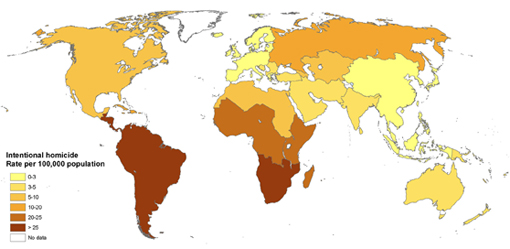

Honduras is on the path to having the highest murder rates in the world.
Jamaica is a perennial crime capital of the Caribbean -- which is saying quite a lot.
Latin America is often dangerous, but if you look you should find some safe havens.
Part of the problem involves race. As we have noted before, in the US, African American males are the worst offenders. Take away African American crime from the US, and the country compares well with the best of Europe on that score. Areas of the world with large populations of African descent will typically have high rates of violent crime. Low IQ and low impulse control appear to be the most likely heritable traits contributing to high violent crime in persons of African descent.
US Hispanics likewise exhibit higher rates of violent crime than both European and Asian Americans, although Hispanic crime rates are not nearly as high as African American crime rates. That being the case, one must wonder why Latin American crime rates rival the worst of African rates.
Part of the problem is the violently competitive drug trade in Latin America. Another part of the problem is the conflation caused by African American populations living in Latin American cities who exhibit high crime rates there. In addition, given the extreme high rates of crime within some indigenous tribes in Latin America, one must allow for the possibility that some behavioural traits contributing to criminal behaviour are inherited within the mestizo communities.
Given these possible reasons for high crime in Africa and Latin America, it should be clear that the politically correct agenda of modern leftists will be of absolutely no help at all in lowering third world crime rates.
So what do we do? First of all, immigration from the third world into the advanced world should be severely curtailed immediately. Second, black markets within the advanced world which contribute to third world crime should be crippled, using market means and deregulation as much as possible rather than law enforcement. Third, every effort should be made to aid the deportation of third world career criminals who have taken up residence within advanced nations.
More on this topic later.
And You Thought There Was No Such Thing As Zombies!

This zombie movement is spurred by a global economic recession without apparent end. And the zombie contagion is spreading...
Thousands of people across the world railed against corporate power, grinding poverty and government cuts Saturday as the Occupy Wall Street movement spread to the streets of Europe, Asia and Australia -- and took a particularly violent turn in Rome....
...Police said hundreds of anarchists in Rome moved in where peaceful demonstrators had gathered as part of the global Occupy movement. The anarchists -- some wearing ski masks and belonging to a group termed "Black Bloc" -- torched cars, broke windows and clashed with police.
...In London, protester Peter Vaughn, reflecting the mood of many in the crowd there, said people criticized financial institutions that have "gambled away our money."
...Europeans turned out amid debt troubles and austerity plans in Greece, Belgium, Italy, Spain, Ireland, Portugal and Germany.
United for Global Change -- the central site for the movement organizing worldwide protests -- said 951 cities in 82 countries were to take part in the demonstrations after online organizers called for a worldwide rally.
...Around the world, protesters marched, listened to speeches, and displayed banners reading anti-corporate slogans, including the now ubiquitous "we are the 99%," "Banks are cancer" and tax the rich 1%."
...Canadians turned out in Toronto, with placards jutting up from a crowd saying "Arrest the 1%" and "Stop ignoring the youth, we are your tomorrow." A sign on a dog said "99% against (corporate) fat cats."
...Australian cities of Melbourne and Sydney joined rallies against "corporate greed" as protesters aligned themselves with the global movement.
...The worldwide movement is galvanized by the Occupy Wall Street movement started last month as a backlash against the economy and what demonstrators say is an out-of-touch corporate, financial and political elite.
Occupy Wall Street organizers say they are inspired by the Arab Spring that led to the toppling of regimes in Tunisia and Egypt. _CNN


Wednesday, October 12, 2011
President Obama Makes Economic Prediction Easy
Growing a healthy economy is very much like growing a healthy garden. Economies need the proper conditions to grow, just as gardens do. When a gardener is neglectful of his garden, one can predict a poor result long before the crop is due to mature. The same thing applies to the managers of an economy. Bad -- incompetent or even malicious -- managers make prediction of the future easy.
US President Obama rode into the White House on a huge wave of hope, change, and popular enthusiasm. Everywhere he went, he was met by huge and adoring crowds. Expectations for this new president were astronomically high . . . . and then something happened -- the new president was inaugurated and put in a position where he had to accomplish something, for the first time in his life.


It is easy to see where the economy was going when the gardener is a narcissistic clown of no achievement and no competence, such as Obama. Never having participated in the productive private sector, Obama had no interest in seeing the prospering of markets and trade.
Consequently, debt has ballooned, the dollar has progressively lost value, the cost of consumables has exploded, jobs have disappeared in the millions, wages have shrunk, government has grown, regulations that make starting businesses difficult have proliferated, gold and silver prices have soared, and anyone with cash is holding onto it, just waiting for a glimmer of hope -- such as the Obama's packing up and moving out of the White House.
Of course, the damage Obama has done will live on for many years and decades. Once government regulations and departments are established, they can become almost impossible to remove -- no matter how destructive they are to the prosperity and well-being of the people.
And yet, economic seeds of prosperity -- just like the seeds of plants -- are still there waiting for the proper conditions that will allow them to bloom and grow. Growth and prosperity will be much spottier than they would have been without Obama, but they will come back to parts of the US. Look to the places where shale oil & gas fracking are being done to see pockets of prosperity so strong as to resist even Obama's attempts to shut them down.
The Obama economic agenda is equivalent to a "salting of the soil" approach to gardening. But even salt-toxic soil can be remediated so that healthy growth can take place again. But as I said, the post-Obama recovery in the US (and consequently around the globe) will be spotty. Keep your eyes open. Pay attention.
Predicting the economy will not be so easy when a different president is elected.
Cross-posted from Al Fin
Tuesday, October 11, 2011
Quick! Someone Tell Tea Partiers that Herman Cain is Black!
Either the Tea Partiers were never properly instructed in the art of being racists, or they are unaware that presidential candidate Herman Cain is black. Cain is enjoying increasing support among members of the Tea Party movement and among the more conservative GOP voters. Walter Russel Mead wants to know how the media "spin" on the Tea Party went so badly wrong:
I suppose it takes at least 4 years of university indoctrination to learn how to ignore reality, and stick to the approved message. All of those paid demostrators at the "Occupy" sit-ins, for example, must be exceptionally well indoctrinated. They must have at least 8 or 10 years of college apiece, on average. All that self righteousness on display, and $22 an hour too! Just to protest in support of the Obama status quo. Heh! And the media skanks love the "occupiers", too, not like the Tea Party rough-housers, rabble rousers and racists.
Either a lot of Democrats have been slandering millions of American voters as racist, or the Tea Party hasn’t gotten the word that Herman Cain is African American. That is the only conclusion that can be drawn after a slew of recent polls shows that Cain is picking up the ‘teavangelical’ vote as former favorites like Michelle Bachmann and Rick Perry fade.Mead goes on to describe a few other incongruities between the skankstream media spin on southern US voters and the reality on the ground.
In particular, this morning we get the word from my native state of South Carolina that Cain is the leader in the Republican primary there. According to this American Research Group poll, Cain has a small and statistically insignificant lead over Mitt Romney: 26 percent to 25 percent.
Unless there has been a heretofore unnoticed surge of Black voters into the ranks of the South Carolina GOP, this means that one out of every four voters in the most conservative electorate in the United States are now ready to vote for a Black candidate for president. _WalterRusselMead
I suppose it takes at least 4 years of university indoctrination to learn how to ignore reality, and stick to the approved message. All of those paid demostrators at the "Occupy" sit-ins, for example, must be exceptionally well indoctrinated. They must have at least 8 or 10 years of college apiece, on average. All that self righteousness on display, and $22 an hour too! Just to protest in support of the Obama status quo. Heh! And the media skanks love the "occupiers", too, not like the Tea Party rough-housers, rabble rousers and racists.
Monday, October 10, 2011
The Age of Professional Activists: Protest as a Permanent Avocation
Billionaire George Soros who is backing the protests for reasons still not clear will probably have to rethink.
On Monday one of the demonstrators wore a T-shirt with the message, "The present is struggle. The future is ours. - Che". Another protestor had a placard with the Latin American revolutionary Che Guevara on it, and it read: "Si se puede - The workers' struggle has no borders". _allAfrica
Left-wing Obama supporters, ‘Occupy Wall Street’ protesters have continued a third week of demonstrations conveying “hope” that President Barack Obama will continue on with “change” and his path of socialist reforms and anti-capitalist government policies.
The movement has earned the financial support and public endorsement of [billionaire curency market manipulator] George Soros, which means Obama may soon coordinate community activism from the White House. _DallasBlog

...what are OccupyLA, Occupy Wall Street and other movements like them? What do they think about? Where do they hope to get?Who is paying these people to sit around and "protest" for weeks at a time? Labour unions? Community organiser grous like ACORN? Obama's DNC? Difficult to say. But the blatant lack of an agenda -- other than to support Obama when he is down -- is rubbing some genuine activists the wrong way.
“Our message right now is very vague. It’s left vague, slightly intentionally,” Davis says as passing cars honk in support and news cameras lurk nearby. “What we’re trying to do is unify a voice.”
Such is life in New York, Los Angeles and other venues throughout the U.S. for those that have taken up this “vague” cause that seems to have put a bulls-eye on Wall Street’s back. Bands of mostly young adults are gathering in normally peaceful settings to generally express their outrage over the inequity between the haves and have-nots. _Marketwatch
“If you are doing a protest you need to have an agenda. If you wake up in the morning and poke a guitar, take a drum downtown and someone is singing and another one is dancing and movie stars are coming and saying do this, do that… and everyone is confused, you’ll be there for a long time.”To be sustained, such a pointless, waste-of-time movement requires some deep-pockets supporters, such as George Soros, organised labour, big-money green movements, and socialist / communist movements which get their money from the international shadows.
Some pundits believe that a likely avenue for Occupy Wall Street is to develop into a left-wing version of the conservative Tea Party movement.
The Tea Party has likewise lacked unity over much other than anger at the status quo. Yet it proved a powerful weapon during the 2010 congressional elections.
According to this scenario, the youth-driven activists of Occupy Wall Street would then reignite Obama’s tattered base just in time for what will likely be a bitter reelection fight in 2012.
A budding alliance between the activists and high-profile trade unions already has the potential to generate considerable street power. _BigGovernment

With the bandwagon alliance of media whore protestors and the mainstream media growing and firming up nicely, expect to see more protests -- perhaps with a bit more gratuitous violence for extra emphasis. At least until the weather grows nasty in the northern US states. At that point, the protests may move into the sun belt.
As long as George Soros and the other big money backers of Obama wish to keep up the charade of serious protests, US media consumers are apt to be hammered by this pretend activism political street theatre. You can get a lot of activism as long as you are willing to pay for it.
The Tea Party activists, on the other hand, held limited events, and always cleaned up after themselves. They had jobs and families to attend to after all, and they took their responsibilities seriously.
The Obama style professional troupe of activists, on the other hand, just live to do what they are doing. They are protesting, you see, for the status quo. A very odd breed of activist indeed.
Friday, September 30, 2011
Putin's Return to the Presidency: Russia's Limited Options
Russia is a vast country, rich in natural resources and energy wealth. But Russia's core population of ethnic Russians is shrinking and aging. The industrial infrastructure of Russia -- including its military infrastructure -- is rusting and losing its human capital via natural loss and out-emigration. Russia's political aristocracy continues shipping the nation's wealth to overseas banks and investments. And the core of Russia's hopes -- the health and optimism of its citizens -- is in decline.
Here are a few other problems that Russia will face under Czar Putin:
Putin is seen as the "strong man" president. But if the declining nature of Russia's military technology and power is exposed to the world, inadvertently, Putin will find it all the harder to maintain order. And such an exposure becomes ever more likely with the passage of time, and the increasing bellicosity of Mr. Putin's regional bullying.
Russia cannot supply its army with a full contingent of ethnic Russians. In Georgia, it was forced to use Muslim mercenaries to do a lot of its dirty work. Putin will be forced to depend upon more and more non-Russians serving within the ranks of the Russian armed forces, and of divided loyalties.
Putin will find it difficult to keep Chinese influence out of Eastern Siberia, as more and more illegal Chinese immigrants move in and occupy the towns and industries there. Russians have never wanted to live in Siberia in large numbers, and the shrinking demographic dynamic is hitting the ethnic Russian population of Siberia very hard.
Looking at the underlying fundamentals, Russia has no alternative to Putin.
Russia's options are limited, after having so many of its non-Kremlin institutions destroyed by the Putin machine. Putin sees anything that he does not directly control as a direct threat to his power, and so he will continue to try to destroy anything new that tries to form an independent existence in Russia.
Any outside entity stupid enough to form an alliance or partnership with Putin's Russia is certain to be badly shafted by the czar, if the opportunity arises.
The best strategy for the rest of the world in dealing with Putin's brave new Russia, is to do everything possible to reduce the international prices of oil & gas. Since Obama's energy starvation policies are oriented toward doing exactly the opposite of that, Obama simply must go.
Here are a few other problems that Russia will face under Czar Putin:
For the last ten years, the Russian government's budget has ballooned, from 1.96 trillion rubles in 2000 to 20.4 trillion rubles in 2011 ($63 billion to $680 billion). Much of this spending has come in the form of direct tributes to regional governors, as well as to some ministries and their officials. It will be difficult to maintain this level of expenditure, since today, more than at any other moment in Russia's history, state revenues depend on the price of fossil fuels; oil, gas, and other petroleum products make up 72 percent of exports. If oil prices continue to fall, Putin may have to cut the budget, which could have a dangerous and unpredictable effect.
A new Putin presidency will cause the Russian public's passive dissatisfaction with their country and its rulers to grow and become more active, reflected by an increased outflow of educated professionals to other countries. Some opposition groups will form, perhaps based on Internet communities, brought together by a sharp rejection of bureaucratic arbitrariness and cynicism. _ForeignAffairs
With Putin’s return to the Kremlin, analysts are predicting a new “brain drain”—an exodus of Russia’s educated and creative young professionals who will not see a future with a ruler that plans to remain in power longer than Joseph Stalin (on the current timetable, until 2024). Another likely result is a renewed crackdown on what remains of Russia’s independent media and the already-illusive civic freedoms; a new round of repressions against the regime’s political opponents; continuing corruption; and a more confrontational stance toward the West and the ex-Soviet “near abroad,” especially as Russia’s increasingly shaky economic situation will necessitate diverting people’s attention elsewhere (the government recently admitted that the budget would only balance at an elevated oil price of $116 per barrel—with the current price being $104).
The most dangerous result of Putin’s attempt to cement his power, however, is an increased likelihood of upheavals. Popular discontent is rising: the August surveys by the independent Levada polling agency showed that 54 percent of Russians disapprove of the current government, while 64 percent would like to see the composition of the United Russia–dominated Parliament change “significantly” or “totally.” According to the same polling data, most Russians also believe that the upcoming parliamentary elections on December 4 will be a farce. With nine political parties across the spectrum—from the left-wing United Labor Front to the center-right Popular Freedom Party—denied registration and barred from the ballot, and a strict de facto censorship operating on national television, it is difficult to disagree with them. _WorldAffairs
We have known since 1996 that Russia wasn’t a democracy. We now know that Russia isn’t a dictatorship controlled by one party or one dynasty. It is a regime ruled by one man. “The party doesn’t exist,” said one of Russia’s leading independent economists. “The politics is all about one person.”As the price of oil fluctuates, the Russian government's hold upon its people's loyalty will likewise fluctuate. Time is working against Putin in this regard, rather than for him as most pundits appear to think. The Arctic, for example, is more likely to freeze a harder thicker ice cap rather than to thaw and create a sea passage, and open drilling zones. The growth of the shale oil & gas industry in Europe threatens to severely reduce one of Russia's most lucrative markets. In addition, substitutions of other feedstocks in place of crude oil in many areas from transportation to plastics, is likely to put a downward pressure on Russia's Ural crude prices.
That new reality might seem to be a victory for Mr. Putin. But it is a flawed triumph. His resumption of absolute power is also an admission that he and his cronies have failed in the project they set themselves in 2008. That was to create a self-replicating institutional base for the regime he brought to power in 2000, when he took over from Boris Yeltsin and dismantled the fledgling democratic structures.
Russia’s transformation into what political scientists call a sultanistic or neo-patrimonial regime is a break both with Russian history and with the global trend. The Kremlin has been home to plenty of murderous dictators. But the czars drew their legitimacy from their blood and their faith. The general secretaries owed their power to their party and their ideology. Mr. Putin’s rule is based solely on the man himself. _Globe&Mail
Putin is seen as the "strong man" president. But if the declining nature of Russia's military technology and power is exposed to the world, inadvertently, Putin will find it all the harder to maintain order. And such an exposure becomes ever more likely with the passage of time, and the increasing bellicosity of Mr. Putin's regional bullying.
Russia cannot supply its army with a full contingent of ethnic Russians. In Georgia, it was forced to use Muslim mercenaries to do a lot of its dirty work. Putin will be forced to depend upon more and more non-Russians serving within the ranks of the Russian armed forces, and of divided loyalties.
Putin will find it difficult to keep Chinese influence out of Eastern Siberia, as more and more illegal Chinese immigrants move in and occupy the towns and industries there. Russians have never wanted to live in Siberia in large numbers, and the shrinking demographic dynamic is hitting the ethnic Russian population of Siberia very hard.
Looking at the underlying fundamentals, Russia has no alternative to Putin.
Russia's options are limited, after having so many of its non-Kremlin institutions destroyed by the Putin machine. Putin sees anything that he does not directly control as a direct threat to his power, and so he will continue to try to destroy anything new that tries to form an independent existence in Russia.
Any outside entity stupid enough to form an alliance or partnership with Putin's Russia is certain to be badly shafted by the czar, if the opportunity arises.
The best strategy for the rest of the world in dealing with Putin's brave new Russia, is to do everything possible to reduce the international prices of oil & gas. Since Obama's energy starvation policies are oriented toward doing exactly the opposite of that, Obama simply must go.
Thursday, September 29, 2011
China's Overreliance On Government Directed Investment
China's property bubble is set to burst, causing greater damage to the domestic economy than the U.S. suffered after its housing market collapsed in 2008, a government economist warned in comments published Friday. Yi Xianrong, a researcher at the Chinese Academy of Social Sciences with a reputation for speaking out against the government's housing policy, said the U.S. housing bubble was smaller than China's and still burst, despite the country's superior legal and credit systems. _SeekingAlpha
China’s problem, however, is that most of this investment is state-directed and this means China’s investment expansion is arguably more likely to create a financial bubble and be less productive than that of the US, Germany et al before it. Again, past is prologue. Both Korea and Japan’s investment spree ended with a bubble bursting – Korea’s in the Asian financial crisis in 1997 and Japan’s in 1990. _FTRead both of the articles above in their entirety, for a balanced view of China's predicament.
When China's export markets collapsed in 2008, the CCP government turned to local infrastructure spending to maintain employment and GDP growth. But much of the spending and construction occurred on the basis of government direction, rather than in response to the needs of any market. This type of central economic planning led to the collapse of the old USSR, and is leading to chronic creeping poverty in Cuba, North Korea, and increasingly in Venezuela.
China's regional governments are going further and further out on an economic limb to finance projects which may look good on the balance sheets, but which will not provide enough return to pay back the loans which were extended to finance them. The famous "ghost cities," "ghost shopping malls," "ghost trade centres," and such are but the tip of the iceberg.
When this widespread overextension of banks, governments, state-owned enterprises, and politically well-connected enterprises becomes stressed sufficiently, the painful effects of this misallocation of capital and the "Potemkin economy" will be more difficult to hide.
Wednesday, September 28, 2011
Black Mob Invades Home and Beats Innocent Husband

ABOUT 11 P.M. on Sept. 9, dozens of youths with bats and pipes descended on a tidy residential area of Port Richmond looking for white teens who allegedly had attacked an African-American kid at Stokely Playground a couple of hours earlier.Philadelphia has been the scene of several violent flash mobs this summer, populated almost entirely by black youth. Even Philadelphia's black mayor has lost patience with the violence among the black youth of his city. But he -- and other responsible black adults in the community -- is apparently helpless to put the cork back in the bottle.
Two fearful white teens spotted Mark LaVelle on Indiana Avenue near Belgrade Street and asked for help. Suddenly, the mob appeared. LaVelle, who said that he didn't know the two kids, who looked to be 13 or 14, ran with them into his nearby house.
" 'We got you, you white mother-------!' " LaVelle said he heard someone yell in the "mob" of black and Hispanic youths.
Inside his house, LaVelle, 37, called to his wife, Kim, 30, to go to their bedroom with their twin 13-month-old boys, Mark and Mason, and to call police. He also ordered his two other sons, 11 and 17, and his nephew, 7, to stay upstairs.
With the two teens hiding in the house, LaVelle, 5 feet 10, 220 pounds, a well-known sports-league organizer and coach in the community, went outside to try to calm the angry mob.
They were standing on his steps. One shouted, " 'Something's going to happen now!' " LaVelle recalled in an interview Friday at his house. LaVelle got nervous and went back inside, locking his door with a deadbolt.
But the attackers pounded on his front windows and kicked his wooden door so hard, it flew open and some of them entered his house.
"The first guy hits me with a pipe. The second guy knocks me in the face. All I'm hearing is my wife and kids screaming," said LaVelle, who feared that the next time they saw him, he would be in a casket.
He said that he was able to push the attackers out the door, but then a third man - who had a gun - tried to extend his arm. LaVelle grabbed onto the gunman's lower arm and shoulder so he couldn't raise the weapon. Then, police sirens screamed in the neighborhood, and the mob turned and ran.
LaVelle was able to identify three of the people from the melee. He said he did not know if they had been chasing the white teenagers, or if they were just trying to find someone to attack.
Police arrested Bergson Morin, 21, of Rosehill Street near Wyoming Avenue, Feltonville, as the man with the gun. They arrested Enrique Delgado, 32, of Rockland and C streets, Feltonville, as the man who hit LaVelle with the pipe. And they arrested a 17-year-old juvenile as the one who punched LaVelle in the face, giving him a black eye.
LaVelle said that the next day the mother of the juvenile came back with some other people, banging on his door, screaming. LaVelle, who was at a charity sports event, was called back to the house by one of his sons.
When he got home, LaVelle said, the mother yelled at him, " 'You white mother------, you got my kid locked up! You got my son locked up because he's black, you're white!' " The mother claimed that her son had been "a witness," not an attacker. To that, LaVelle said if that were true, it would come out in court.
But the mother, according to LaVelle, then yelled: " 'If you make it to court! I know where you live!' "
Police public affairs could not confirm yesterday if the mother has been arrested for making threats. _Philly.com
Here is the kind of news story that Philadelphians are becoming more accustomed to hearing. Philadelphia is a demographic horror story in the making, an illustration of demographic replacement by a more violent and less productive population group than the group it replaced. It is the same story across many cities in North America, as well as a growing problem in Europe, the UK, and Australia.
Political correctness prevents modern people of good will from calling the phenomenon what it is -- and stops them from taking the necessary steps to put an end to the violence. And so it will continue to get worse for as long as the violent perpetrators are sheltered by politically correct authority and law enforcement. Too bad.
Saturday, September 24, 2011
Which Comes First? Collapse of Commodities Prices, or the Crumbling of BRICs?
Common wisdom assumes that commodity prices, including oil prices, will continue to rise on exponential demand from emerging nations, such as China, India, Brazil, Turkey, Russia, etc. But under the sheen of those rosy projections, exists a growing excremental stench of corruption and decay. If the magical trajectory of the BRICs should falter, how far would commodities prices fall? And what would be the repercussions for already stressed world financial markets, desperate for safe havens and hedged to the hilt?
When commodity prices dive, Russia may well grow desperate.
Russia's ongoing demographic collapse, and the threat of losing much of Eastern Siberia to Chinese influence, is not helping the mood in Moscow. But without the clout that comes from high energy prices, Russia becomes an angry dancing toy bear with nuclear weapons.
Venezuela, Iran, the Arab states of MENA, Mexico, and many countries in tribal Africa and Asia, are also pathologically dependent on high commodity prices, due to internal corruption having squeezed natural markets to death. How will their people deal with the many difficulties and hardships they will face when their governments cannot feed, clothe, house, or water them?
Even the US is vulnerable to a fall in commodities prices. The US is the world's third largest oil producer. The recent boom in US shale oil & gas production is one of the few bright lights in an otherwise dim Obama economy. And although the jobs, housing, manufacturing, and other sectors in the US economy continue to sag, Obama has not had enough time to entirely destroy the US private sector.
Few readers of this blog understand the precarious state of China's economic house of cards. That is because almost all of the economic information coming out of China is closely controlled, and coated with a shiny facade. But it is time for readers to begin asking themselves about the global repercussions of a more sustained commodities price slump than they have seen.
Taken from an earlier article at Al Fin
China's property bubble is set to implode, and when it does, the Chinese economy will cool far more than anyone thinks, taking commodities along for the ride. Commodity producers like Australia and Canada are at extreme risk as well. _MishNot just Australia and Canada are at extreme risk. Two BRICs -- notably Russia and Brasil -- are gambling on continued high commodity prices into the indefinite future. Corruption in all of the BRICs is hampering genuine market-based growth, but economic dependence on raw commodities prices is particularly bad in Russia.
When commodity prices dive, Russia may well grow desperate.
Prime Minister Vladimir Putin, the country's uncrowned czar, has linked his legitimacy to the economy's performance by offering the Russian people a grand bargain: submit to his increasingly autocratic rule and the state will compensate with economic goodies like higher incomes and hefty social-welfare spending. Now that the economy is faltering, Putin is under intensifying pressure from a discontented public to restore Russian democracy, potentially destabilizing Russian politics. He has already faced protests in Moscow against his rule amid the economic downturn. There's also a risk that leaders in Moscow will resort to nationalistic appeals to distract the public from problems at home, escalating tension with Russia's neighbors, the rest of Europe and the U.S. _Time
Russia's ongoing demographic collapse, and the threat of losing much of Eastern Siberia to Chinese influence, is not helping the mood in Moscow. But without the clout that comes from high energy prices, Russia becomes an angry dancing toy bear with nuclear weapons.
Venezuela, Iran, the Arab states of MENA, Mexico, and many countries in tribal Africa and Asia, are also pathologically dependent on high commodity prices, due to internal corruption having squeezed natural markets to death. How will their people deal with the many difficulties and hardships they will face when their governments cannot feed, clothe, house, or water them?
Even the US is vulnerable to a fall in commodities prices. The US is the world's third largest oil producer. The recent boom in US shale oil & gas production is one of the few bright lights in an otherwise dim Obama economy. And although the jobs, housing, manufacturing, and other sectors in the US economy continue to sag, Obama has not had enough time to entirely destroy the US private sector.
Few readers of this blog understand the precarious state of China's economic house of cards. That is because almost all of the economic information coming out of China is closely controlled, and coated with a shiny facade. But it is time for readers to begin asking themselves about the global repercussions of a more sustained commodities price slump than they have seen.
Taken from an earlier article at Al Fin
Saturday, September 17, 2011
Warfare Between Generations Still Largely Covert
...young Japanese and Italians pursue increasingly cautious lifestyles. Nearly 80 per cent of unmarried Japanese between the ages of 18 and 35 live with their parents. The ratio is nearly as high in Italy.
Such unadventurous living means people do not grow up, and do not take risks – such as having children or starting a business. _WRM
Italy and Japan are the leading edge of this global demographic transition within developed countries. Russia is experiencing much of the same phenomenon, as is much of Europe, North America, and Oceania.
In Italy and Japan, companies are reluctant to hire young people on what American universities call “tenure track”; unsure about their future needs and resources they don’t want high cost employees that can’t be fired. The older workers are too powerful to dislodge — just as in American universities the tenured professors are too powerful to give up tenure. So younger workers increasingly are hired if at all on temporary contracts, with lower benefits and fewer prospects for promotion. _WRM
The problem is the most dire in countries and regions which have transferred power from the individual and the private sector to the public sector. This willful concentration of power reduces opportunity for newcomers.
To succeed today, many young people need to recognize that no job will be waiting for them when they finish studying. They are going to have to create their own opportunities. It is a good time for creative entrepreneurs. _WRMUnfortunately, in such aging societies there is little opportunity for entrepreneurial initiative. Paralysing taxes, regulations, and public debt leave little room for meeting the real needs of a healthy population.
The welfare state grows and grows, concentrating on meeting the needs of the weak, the old, the diseased, the dispossessed, and the illegal alien outsider. Meanwhile, the young and gifted are shunted aside, unwelcome. People with new ideas and new ways of solving problems are an unwelcome distraction and threat to the political class, and must be struck down and removed from the public stage.
This is happening routinely in Russia, and other dictatorships. But it is also happening less overtly in Canada, the US, and other developed democracies.
The war between the generations -- and between styles of thinking -- remains mostly covert. But that could change quickly. If you do not want your nation to flare up in outright inter-generational warfare, consider changing the way your government solves problems.
Friday, September 16, 2011
Europe and America: Demographics and Dumbing Down
The gravity of Europe’s demographic situation became clear at a conference I attended in Singapore last year. Dieter Salomon, the green mayor of the environmentally correct Freiburg, Germany, was speaking about the future of cities. When asked what Germany’s future would be like in 30 years, he answered, with a little smile, ”There won’t be a future.”
Herr Mayor was not exaggerating. For decades, Europe has experienced some of the world’s slowest population growth rates. Fertility rates have dropped well below replacement rates, and are roughly 50% lower than those in the U.S. Over time these demographic trends will have catastrophic economic consequences. By 2050, Europe, now home to 730 million people, will shrink by 75 million to 100 million and its workforce will be 25% smaller than in 2000._JoelKotkin_Forbes
When a welfare state is in the throes of a shrinking demographic, the implications are extremely dire. Guarantees of benefits in these nations is based upon a pyramid scheme, with the older pensioners near the apex and the younger taxpayers near the base. If the positions are reversed due to a collapsing demographic, national debt tends to grow to massive proportions rather quickly.
The fiscal costs of this process are already evident. Countries like Spain, Italy and Greece, which rank among the most rapidly aging populations in the world, are teetering on the verge of bankruptcy. One reason has to do with the lack enough productive workers to pay for generous pensions and other welfare-state provisions.
Germany, the über-economy of the continent, has little hope of avoiding the demographic winter either. By 2030 Germany will have about 53 retirees for every 100 people in its workforce; by comparison the U.S. ratio will be closer to 30. As a result, Germany will face a giant debt crisis, as social costs for the aging eat away its currently frugal and productive economy. According to the American Enterprise Institute’s Nick Eberstadt, by 2020 Germany debt service compared to GDP will rise to twice that currently suffered by Greece. _Forbes_Kotkin
The United States under Obama has been trying to imitate the European style of government -- a designed expansion of the public sector at the expense of the private sector. Fortunately for Obama -- in one sense -- the US is not suffering the same demographic collapse as Europe. The US is instead still growing demographically, due to immigration and due to higher birthrates among immigrants.
But in another sense, the US population growth is not as fortunate as it appears. The new replacement populations coming into the US are, on average, of lower aptitude in a cognitive sense. Average IQ of the US population is almost certain to drop as a result, and US global comptetiveness will be strained, consequently.
Trends in SAT test scores are an early warning of this very phenomenon:
"The scores are disappointing, and it seems to be a trend over the last five to six years, with drops across the board," said Jim Hull, senior policy analyst for the National School Board Association's Center for Public Education.
He called 10 points "a pretty significant change."
"It raises a red flag," he said. _WashingtonExaminer
Test score drops will be blamed on a number of factors, but the studiously ignored central cause of this trend is the lowered cognitive potential of modern students. And it is only likely to get worse. And the repercussions of this cognitive decline will spread throughout society -- and will be magnified tenfold by affirmative action policies.
The SAT has already been "dumbed down," perhaps in anticipation of this very phenomenon, but apparently it was not dumbed down enough. It will probably not be long before the ACT follows suit, in politically correct fashion. More: Steve Sailer takes a closer look at changes in SAT scores over the past several years, with stratification of scores by race.
A dumber population will place greater demands on governmental infrastructure. Law enforcement, welfare, education, housing, food subsidies, etc. will all have to grow more productive to compensate for a population of lower cognitive aptitudes.
National debt will increase even faster than at present, as the underlying society grows less capable of repaying their own debt on top of the debt of previous generations. Economic hardship will increase.
Multicultural societies are low-trust societies, which require much larger police forces to maintain order. As police forces are downsized due to the exponential growth in public sector union pensions and benefits, civil disorder will expand to fill the void.
Youth gangs made up almost entirely of immigrants, children of immigrants, and "minority" populations, will range the landscape virtually unimpeded by a law enforcement infrastructure that will grow more corrupt as it takes on the multi-cultural form of the new dominant populations of society. The initiation ritual for many of these gangs is likely to be an act of violence against the shrinking population of the formerly dominant, European descended people.
Can you and yours find a place of safety in this coming world? That depends upon what you do between now and then.
Hope for the best. Prepare for the worst.
Friday, September 09, 2011
Willpower and Stupidity
Is the ancient virtue of willpower still relevant in the modern age?
A more scientific term for willpower is executive function (EF), coordinated in the prefrontal lobes of the brain. Together with intelligence (IQ), levels of EF powerfully determine life success over the years. EF can be improved by training in children, but such training should occur between the ages of 4 and 7 for maximum benefit.
The interaction of willpower and stupidity is more complex than most people understand. First, what do we mean by "stupidity?"
Stupidity arises from multiple causes. Low intelligence, spite, ignorance, laziness (lack of willpower), miscalculation, and unavoidable constraint propagation (bad luck) are just a few of the many causes of stupidity and stupid people.
In the United States, stupidity has become concentrated near seats of power such as Washington DC, New York City, Los Angeles, Chicago, etc. Government is one obvious host and purveyor of mass stupidity, along with all other institutions which are closely involved with government -- such as labour unions, news media, education, financial and economic institutions, law enforcement, the courts etc. Even the military -- which believe it or not is the most competent branch of government -- has been infiltrated by politically correct stupidity via social promotion of PC-favoured officers and the enforcement of politically correct policies.
Labour unions have become the seat of stupidity in a particular way recently, thanks to the union-friendly Obama regime. A violent storming, vandalism, and assault of a port in Washington state goes unpunished by government officials. While warming up a crowd for President Obama, Jimmy Hoffa Jr. tells Obama to "take out the son of a bitches," referring to Tea Party members and Republicans, and neither Hoffa nor the Obama White House will apologise for this rather blatant lapse of civility in the midst of an official Obama event. AFL-CIO head Richard Trumka dictates to Obama what he needs to say in his jobs speech before a joint session of congress -- encouraging the president to "go to the mat" -- and is rewarded for his presumption by being seated next to Michelle Obama for the president's speech.
These are all examples of stupidity by labour union officials and thugs. But many more similar examples occur on a regular basis. If the general public were to become widely aware of this stupidity, the political fortunes of Mr. Obama and those close to him would deteriorate even more quickly than at present. But for now, the news media continues to overlook and cover up the mistakes of Obama and his friends.
Mr. Obama's stupidity is not only in his friends and hangers on, but is engrained in every policy that he has pursued since being inaugurated. His war against the private sector, his war against energy, his promotion of a bankrupting "green jobs agenda," his vilifying of national allies and his cozying up with national antagonists, his diverting of scarce national assets into the purses of political cronies, his irreversible expansion of government mandate and government debt, his unprecedentedly divisive effect on society -- all of these evidences of stupidity and more should be enough to portray Obama's administration as "the stupid regime."
It should be obvious that willpower is not a simple antidote to stupidity. In fact, stupid people often pursue their stupid agendas with the utmost will.
It is true that if the masses had exerted more willpower in their oversight of government and government officials, that this massive clusterfuck could have never grown so bad so quickly. But that was then, and this is now. What do we do now?
Can the example problem -- the rise of stupidity in US government and society -- be solved within the political and societal structure, or will entirely new structures and forms of organisation be necessary?
This question will be explored in future articles.
Cross-posted from Al Fin blog
We eat, drink, smoke and gamble too much, max out our credit cards, fall into dangerous liaisons and become addicted to heroin, cocaine and e-mail.
...In experiments beginning in the late 1960s, the psychologist Walter Mischel tormented preschoolers with the agonizing choice of one marshmallow now or two marshmallows 15 minutes from now. When he followed up decades later, he found that the 4-year-olds who waited for two marshmallows turned into adults who were better adjusted, were less likely to abuse drugs, had higher self-esteem, had better relationships, were better at handling stress, obtained higher degrees and earned more money. _NYT
A more scientific term for willpower is executive function (EF), coordinated in the prefrontal lobes of the brain. Together with intelligence (IQ), levels of EF powerfully determine life success over the years. EF can be improved by training in children, but such training should occur between the ages of 4 and 7 for maximum benefit.
The interaction of willpower and stupidity is more complex than most people understand. First, what do we mean by "stupidity?"
"A stupid person is a person who causes losses to another person or to a group of persons while himself deriving no gain and even possibly incurring losses."
"Always and inevitably everyone underestimates the number of stupid individuals in circulation."
"Non-stupid people always underestimate the damaging power of stupid individuals. In particular non-stupid people constantly forget that at all times and places and under any circumstances to deal and/or associate with stupid people always turns out to be a costly mistake."
"Our daily life is mostly, made of cases in which we lose money and/or time and/or energy and/or appetite, cheerfulness and good health because of the improbable action of some preposterous creature who has nothing to gain and indeed gains nothing from causing us embarrassment, difficulties or harm. Nobody knows, understands or can possibly explain why that preposterous creature does what he does. In fact there is no explanation - or better there is only one explanation: the person in question is stupid." _Science20
Stupidity arises from multiple causes. Low intelligence, spite, ignorance, laziness (lack of willpower), miscalculation, and unavoidable constraint propagation (bad luck) are just a few of the many causes of stupidity and stupid people.
In the United States, stupidity has become concentrated near seats of power such as Washington DC, New York City, Los Angeles, Chicago, etc. Government is one obvious host and purveyor of mass stupidity, along with all other institutions which are closely involved with government -- such as labour unions, news media, education, financial and economic institutions, law enforcement, the courts etc. Even the military -- which believe it or not is the most competent branch of government -- has been infiltrated by politically correct stupidity via social promotion of PC-favoured officers and the enforcement of politically correct policies.
Labour unions have become the seat of stupidity in a particular way recently, thanks to the union-friendly Obama regime. A violent storming, vandalism, and assault of a port in Washington state goes unpunished by government officials. While warming up a crowd for President Obama, Jimmy Hoffa Jr. tells Obama to "take out the son of a bitches," referring to Tea Party members and Republicans, and neither Hoffa nor the Obama White House will apologise for this rather blatant lapse of civility in the midst of an official Obama event. AFL-CIO head Richard Trumka dictates to Obama what he needs to say in his jobs speech before a joint session of congress -- encouraging the president to "go to the mat" -- and is rewarded for his presumption by being seated next to Michelle Obama for the president's speech.
These are all examples of stupidity by labour union officials and thugs. But many more similar examples occur on a regular basis. If the general public were to become widely aware of this stupidity, the political fortunes of Mr. Obama and those close to him would deteriorate even more quickly than at present. But for now, the news media continues to overlook and cover up the mistakes of Obama and his friends.
Mr. Obama's stupidity is not only in his friends and hangers on, but is engrained in every policy that he has pursued since being inaugurated. His war against the private sector, his war against energy, his promotion of a bankrupting "green jobs agenda," his vilifying of national allies and his cozying up with national antagonists, his diverting of scarce national assets into the purses of political cronies, his irreversible expansion of government mandate and government debt, his unprecedentedly divisive effect on society -- all of these evidences of stupidity and more should be enough to portray Obama's administration as "the stupid regime."
It should be obvious that willpower is not a simple antidote to stupidity. In fact, stupid people often pursue their stupid agendas with the utmost will.
It is true that if the masses had exerted more willpower in their oversight of government and government officials, that this massive clusterfuck could have never grown so bad so quickly. But that was then, and this is now. What do we do now?
Can the example problem -- the rise of stupidity in US government and society -- be solved within the political and societal structure, or will entirely new structures and forms of organisation be necessary?
This question will be explored in future articles.
Cross-posted from Al Fin blog
Monday, September 05, 2011
Vladimir Putin's Russia a KGB State: What Does it Mean?
The Russian economy is dependent upon the world markets for oil & gas. As long as world oil & gas prices are high, the Russian economy will do well, and the Russian government will be able to buy the grudging obedience of its people.
Why cannot Russia grow a prosperous economy that is more independent of its massive oil & gas reserves, and mineral resources? The answer to that question rests in the way Putin's government controls Russian industry and resources: like a KGB state.
By preventing the growth of a healthy private sector, Russia's KGB state maintains solid control over a permanently stunted economy. Better to rule in hell than to serve in paradise, as the head demons tend to say.
This cozy little cesspool is doomed, of course. Demographic decline at both ends of the lifespan insure an ever-shrinking population. The abysmal state of Russian medicine and public health continues to worsen. Massive quantities of capital are being rushed out of the country every week. And anyone with any talent or appeal to outside interests is pushing her case for foreign employment, marriage, or just plain emigration out of the doomed KGB state that Putin has built.
Again, we have to ask the question: Will a country with such a massive stockpile of nuclear weapons go quietly into the dark night of failed states, when the time comes to exit the stage? Not likely. Expect Russia to resurrect the role of global troublemaker which it performed so well when the USSR had its KGB state.
Why cannot Russia grow a prosperous economy that is more independent of its massive oil & gas reserves, and mineral resources? The answer to that question rests in the way Putin's government controls Russian industry and resources: like a KGB state.
Under Putin's direction, a "state mafia" has replaced the street mafias of the chaotic Yeltsin years. At the bottom of this mafia's pecking order, armies of corrupt tax, fire and health inspectors have taken the place of the brawny young street thugs and racketeers of the Yeltsin era. They can ruin any small or medium-sized business that does not cooperate with them. At higher levels, municipal and regional officials allocate contracts, receive bribes from local businesses, wipe out fines or indictments, and look the other way in the case of unsafe cruise ships. At the top of the ladder, ministers and deputy prime ministers have replaced private oligarchs as heads of gigantic energy and mineral concerns. They deal with their victims politely in fancy hotels and modern offices, but the result is a classic shakedown worthy of the New Jersey mafia. _econlibIn other words, companies do not prosper on the basis of good products, services, and customer relations. Rather, companies in Russia prosper on the basis of whose palm is greased, and whose political interests are not being threatened.
The KGB state has created a thug economy. Its directors use businesses as personal wealth-generating machines; they quash potential competitors and take over legitimate businesses once they become big enough to attract their interest. The directors of the KGB economy have accumulated incredible wealth. Putin himself is said to be the richest of the bunch, with a fortune likely in excess of $30 billion.5 There are more Russian than American billionaires on the Forbes lists, although private wealth in Russia is a tiny fraction of that in the United States.By controlling the upper echelons of important Russian industries, Putin's Russia prevents significant improvements in management, technology, and services, from upsetting the carefully balanced apple cart. Such control also assures a quasi-permanent dependency on world commodities markets, and an exquisite vulnerability to outside technology breakthroughs or resource discoveries.
Many praise China's state capitalism and use high Chinese growth rates to justify its one-party state and political repression. Can we make similar claims about Russia's KGB economy? Does it yield returns that somehow justify its negative aspects?
The directors of the KGB state praise their economy as an example of state capitalism that nurtures "national champions" (a term Putin introduced in 1997) like Gazprom, Rosneft, and Aeroflot. They remind the public of the "wild capitalism" of the Yeltsin years, when pensions were not paid and inflation was rampant. They point to the crises of the United States and Greece. They claim that wise leaders like Putin and Medvedev, as well as their ministers and civic-minded oligarchs, protect and promote the economic interests of society.
The KGB state controls the commanding heights (Lenin's term) of energy, commerce, minerals, media, and transportation. Small and medium-sized businesses can operate if they keep their noses clean and heads down and buy off the lower levels of the state mafia. _Paul Gregory_econlib
By preventing the growth of a healthy private sector, Russia's KGB state maintains solid control over a permanently stunted economy. Better to rule in hell than to serve in paradise, as the head demons tend to say.
This cozy little cesspool is doomed, of course. Demographic decline at both ends of the lifespan insure an ever-shrinking population. The abysmal state of Russian medicine and public health continues to worsen. Massive quantities of capital are being rushed out of the country every week. And anyone with any talent or appeal to outside interests is pushing her case for foreign employment, marriage, or just plain emigration out of the doomed KGB state that Putin has built.
Again, we have to ask the question: Will a country with such a massive stockpile of nuclear weapons go quietly into the dark night of failed states, when the time comes to exit the stage? Not likely. Expect Russia to resurrect the role of global troublemaker which it performed so well when the USSR had its KGB state.
How Could a US President Be So Abysmally Ignorant of the Nature of a Market Economy?
Mr. Obama has increased the US national debt by $4 trillion with very little to show for it in the way of employment or jobs. Obama's jobs program has become a program of political payoffs to cronies and supporters, while drowning the private sector under more and more layers of taxes and regulations. How could a US president be so utterly stupid as to how market economies work?
But if you ask Obama voters why they voted for him, it is unlikely that they would say "to play golf," or "to go on long and expensive vacations."
Most of us knew that Obama could only be a figurehead, all along. His real world experience is completely lacking of any ingredients for making a strong, competent, practical leader for the world's only superpower and largest economy. What we didn't understand was just how disastrously poor Mr. Obama is at choosing advisors and decision makers. Too late now.
But if anyone within 100 miles of Washington DC does have any idea how a market economy can be allowed to thrive, perhaps he could try to get a message through into the "DC dead zone" that things need to be done in a more competent way, more in accordance with the needs of market economies. Otherwise, the ugliness is apt to get completely out of control.
The heart of the problem is that Obama's idea of job creation largely revolves around public works projects that are rooted in Keynesian economics and driven by government funding and political payoffs.Mr. Obama knows how to read from a teleprompter, and look down his nose at his royal subjects. He can also put in a lot of time on the golf course, and puts on some impressive taxpayer-supported vacations and parties.
What's needed now is a blood transfusion of self-funding jobs in the private sector that will enlarge the tax base and begin shrinking the deficit. Fortunately, there are four initiatives already in motion that could quickly create jobs and have a ripple effect throughout the economy.
First, the president could support the Freedom to Invest Act of 2011 (HR 1834), which would allow American multinational corporations to bring back to the U. S. some of the $1 trillion in cash they are hoarding offshore to avoid onerous U.S. corporate tax rates.
Why not allow those funds to be repatriated at greatly reduced tax rates, provided the money is invested in jobs, plants and equipment in the U.S.?
Second, the president can ask his appointees at the National Labor Relations Board to fast-track the hearings and decision-making that would allow Boeing to open its 787 Dreamliner assembly plant in South Carolina....
Third, President Obama can direct his Interior Department to cut through the red tape and renew the permit granted to ExxonMobil to develop the largest oil discovery in a decade located in the Julia field in the Gulf of Mexico. That discovery -- a deep reservoir of some 1 billion barrels of oil -- would reduce America's dependence on foreign oil and create thousands of jobs.
According to the American Petroleum Institute, by 2013 the ripple effects of this discovery and the lifting of the drilling moratorium imposed after the BP oil spill would cause "total employment supported by the Gulf of Mexico oil and natural gas industry to (approach) 430,000 jobs or a 77 percent increase."
Fourth, jobs are just waiting to be created by American companies eager to help tap the third largest proven oil reserve in the world, located in Alberta, Canada. These oil sands are now technologically and economically viable, provided the heavy crude oil can be transported by a new pipeline to refineries on the Texas Gulf coast.
Eighty percent of that 1,660-mile pipeline would be in the U.S. and put 20,000 people to work in construction and manufacturing. Most of the planning and permitting for the proposed Keystone XL pipeline has been done.
The major holdup now is President Obama. He needs to approve the project and shepherd it through final State Department formalities.
So far, President Obama's jobs initiatives have relied on stimulus spending of public money that is largely borrowed. The debt ceiling debate and S&P downgrade shocked the nation into facing the fact that we must reduce the trajectory of borrowing and spending. The virtue of private sector job creation is that it is largely self-funding and that it provides a return on investment, which in turn generates new tax revenues. _MercuryNews
But if you ask Obama voters why they voted for him, it is unlikely that they would say "to play golf," or "to go on long and expensive vacations."
Most of us knew that Obama could only be a figurehead, all along. His real world experience is completely lacking of any ingredients for making a strong, competent, practical leader for the world's only superpower and largest economy. What we didn't understand was just how disastrously poor Mr. Obama is at choosing advisors and decision makers. Too late now.
But if anyone within 100 miles of Washington DC does have any idea how a market economy can be allowed to thrive, perhaps he could try to get a message through into the "DC dead zone" that things need to be done in a more competent way, more in accordance with the needs of market economies. Otherwise, the ugliness is apt to get completely out of control.
Saturday, September 03, 2011
Out of Control Debt An Important Sign of Global Instability
...leading economies, the U.S., Japan, and the E.U. are declining. That is, about one-sixth of the world's population is losing ground. These big economies are the ones that lead the rest of the world, including China. Countries like China, India, and Brazil, depend on the health of the big economies to keep buying their products and commodities so they can grow and generate wealth for their citizens. _ZeroHedge


A visit to Spain the prior week demonstrated that Greece's financial woes were just the tip of an iceberg on a continent of debt -- the Greek national debt crisis seemed like the first card in a flimsy house. To be in a nation as it is unraveling has an eerie, surreal, mostly indescribable feeling. The storefronts in Athens outside of the tourist areas looked like they'd been through several rounds of a boxing fight, and were just waiting for the knockout punch. Other than the lights being on, the difference between shops closed indefinitely and those currently operating were hard to distinguish. Unless they were pushing merchandise, people wore saddened expressions as they walked by decaying and graffiti-covered buildings. _thetyeeIn such environemnts, deadly, destructive riots are always just a spark away. There is no telling where the next upsurge of violence and mayhem would end.
The situation can only get worse, since nobody's interests align. The Greeks want more time to meet their budget targets without having to make more cuts that would cause more public angst. The Germans, whose opinions arguably matter the most since they have the financial ammo, are already in a huff with German Chancellor Angela Merkel about expanding the eurozone's bailout fund. More pushback from Greece about meeting its current austerity measures only fuels the fire. _Time

Towards the end of the last decade, it was popular to proclaim Europe as an example of what we in North America could achieve. This notion was led by books such as Jeremy Rifkin's The European Dream, which described the difference between North American and European values. He argued that on the other side of the Atlantic, citizens found security not through individual accumulations of wealth but through connectedness, respect for human rights and sustainability. _the tyeeBut now, as Europe's demographics collapses in on itself, we can see that not even utopia can escape the twin demons of debt and demographic decline and collapse. Europe's states are like teetering dominos, as long as they are coupled together economically. But if Europe is smart enough to decouple, still only a portion can survive the coming wildfire.
In the third world, we will have "The Coming Anarchy." In the developed world, the anarchy will focus on the third world enclaves, the multicultural cities and non-assimilating banlieus, and spread out from there.
Consider the relative places of safety, where you might find a place for yourself and your families. Hope for the best, prepare for the worst.
Thursday, September 01, 2011
Two Strikes Against China, Europe; Global Economy Deterioriates
China's two strikes for today are:
1. China's aging population: a demographic time bomb. China is not ready for the demographic sledge hammer rapidly descending upon its head.
2. Massive overcapacity: the limits to government dictate. China's economy was unable to adjust properly to the radical drop in export income dating from 2008, 2009. Bubble trouble in spades.
Europe's daily double:
1. The birth of gangland: Unwise immigration policies lead to societal fragmentation and rising crime
2. Crash of the nanny state: Welfare state economics confronts the shrinking taxpayer demographic collapse. Welfare states are pyramid schemes. They do not work in aging populations. Hence Europe's rapidly growing economic problems.
The US is facing many of the same problems as Europe, and is also burdened with the Obama administration -- arguably the most destructive US presidential administration ever.
Globally, the economic situation is even worse, since the world economy needs for the US and Europe to thrive, to have someone to buy the emerging world's exports. Mish has more about the economic problems from the BRICS to Canada to Asia. There is very little in the global economic picture about which to feel encouraged.
1. China's aging population: a demographic time bomb. China is not ready for the demographic sledge hammer rapidly descending upon its head.
2. Massive overcapacity: the limits to government dictate. China's economy was unable to adjust properly to the radical drop in export income dating from 2008, 2009. Bubble trouble in spades.
Europe's daily double:
1. The birth of gangland: Unwise immigration policies lead to societal fragmentation and rising crime
2. Crash of the nanny state: Welfare state economics confronts the shrinking taxpayer demographic collapse. Welfare states are pyramid schemes. They do not work in aging populations. Hence Europe's rapidly growing economic problems.
The US is facing many of the same problems as Europe, and is also burdened with the Obama administration -- arguably the most destructive US presidential administration ever.
Globally, the economic situation is even worse, since the world economy needs for the US and Europe to thrive, to have someone to buy the emerging world's exports. Mish has more about the economic problems from the BRICS to Canada to Asia. There is very little in the global economic picture about which to feel encouraged.
Subscribe to:
Posts (Atom)