Wednesday, April 26, 2006

Too Stupid to Know . . . . .


.....when people are trying to kill you, part II.

The best description of modern western society, other than incredibly affluent, free, and intellectually fertile, is . . . . fat, dumb, and happy. The two descriptions are not mutually exclusive. A most salient quantity of people in a society may indeed be fat, dumb, and happy--while a relatively invisible group of people works to perpetuate the freedom, affluence, and inventiveness of the society.

An affluent society may very well be on the verge of disaster and not realize it, if the most prominent voices in the society declines to inform the society of its precarious position.

Part one of this series was inspired by the motion picture "A History of Violence," starring Viggo Mortensen. Part two, this installment, is inspired by Dan Simmons' recent "April message." I posted a link to Simmons' message at the Al Fin website, then surfed the web to find out what was being said about the "message" generally.

What I found should not have surprised me. People automatically sorted the ideas in the message according to their pre-existing political viewpoints, rather than critically examining it as a useful provocation to thought. Even science fiction readers (and writers) who enjoyed Simmons' work would heap scorn on Simmons reflexively, if their pre-existing viewpoint (on the threat that Simmons' wrote about) was different than their perception of Simmons' message.

Contrast that ready disregard of a well-written although fictional warning, with the massive world-view changing impact of an event such as the 9/11 World Trade Center attacks. It is easy to deny a threat if couched in fictional trappings. It was not so easy to deny the gaping hole in Manhattan's financial district, so it was necessary to invent massive conspiracy theories that were more absurd than the absurdest fiction. For the lumpenheads, the conspiracy theories took on all the aspects of reality, and became reality.

Regardless, the web reaction to Simmons' message suggested the reason why despite North American society being daily blasted with a (largely fictional) particular version of current events by the mainstream media (both news media and popular media), political opinions remain largely unchanged. Even the massive PC dominance of the universities for the past twenty years has failed to turn most graduates into the PC automatons that the professors so much had wished for, in imitation of themselves.

People subconsciously understand that the media worldview is fictional, just as students understand that a large part of the "officially sanctioned politically correct" viewpoints they are fed at university is likewise fictional. In a time of undeniable reality such as 9/11, it is as easy to shuck off such fictional viewpoints as it is to change jackets or slacks.

Of course, the really bright ones figured things out before 9/11, but that is a story for another time. The next big reality shaking event will knock even more people from the indoctrinated camp to the more thoughtful camp, but a lot of people decided not to wait, not to be too stupid to know . . . .

Friday, April 21, 2006

Europe: Dear Fat Old Girl, Who Can Save You Now?

The following post was "borrowed" from David's Medienkritic blog. It deals with the current state of Europe, and whether in denying this particular crisis, Europe is finally doomed. Or will the cavalry ride over the hill one last time to save the old girl?

Europe – Thy Name is Cowardice

Commentary by Mathias Döpfner

A few days ago Henryk M. Broder wrote in Welt am Sonntag, "Europe – your family name is appeasement." It’s a phrase you can’t get out of your head because it’s so terribly true.

Appeasement cost millions of Jews and non-Jews their lives as England and France, allies at the time, negotiated and hesitated too long before they noticed that Hitler had to be fought, not bound to agreements. Appeasement stabilized communism in the Soviet Union and East Germany in that part of Europe where inhuman, suppressive governments were glorified as the ideologically correct alternative to all other possibilities. Appeasement crippled Europe when genocide ran rampant in Kosovo and we Europeans debated and debated until the Americans came in and did our work for us. Rather than protecting democracy in the Middle East, European appeasement, camouflaged behind the fuzzy word "equidistance," now countenances suicide bombings in Israel by fundamentalist Palestinians. Appeasement generates a mentality that allows Europe to ignore 300,000 victims of Saddam’s torture and murder machinery and, motivated by the self-righteousness of the peace-movement, to issue bad grades to George Bush. A particularly grotesque form of appeasement is reacting to the escalating violence by Islamic fundamentalists in Holland and elsewhere by suggesting that we should really have a Muslim holiday in Germany.

What else has to happen before the European public and its political leadership get it? There is a sort of crusade underway, an especially perfidious crusade consisting of systematic attacks by fanatic Muslims, focused on civilians and directed against our free, open Western societies.
It is a conflict that will most likely last longer than the great military conflicts of the last century—a conflict conducted by an enemy that cannot be tamed by tolerance and accommodation but only spurred on by such gestures, which will be mistaken for signs of weakness.

Two recent American presidents had the courage needed for anti-appeasement: Reagan and Bush. Reagan ended the Cold War and Bush, supported only by the social democrat Blair acting on moral conviction, recognized the danger in the Islamic fight against democracy. His place in history will have to be evaluated after a number of years have passed.

In the meantime, Europe sits back with charismatic self-confidence in the multicultural corner instead of defending liberal society’s values and being an attractive center of power on the same playing field as the true great powers, America and China. On the contrary—we Europeans present ourselves, in contrast to the intolerant, as world champions in tolerance, which even (Germany's Interior Minister) Otto Schily justifiably criticizes. Why? Because we’re so moral? I fear it’s more because we’re so materialistic.

For his policies, Bush risks the fall of the dollar, huge amounts of additional national debt and a massive and persistent burden on the American economy—because everything is at stake.

While the alleged capitalistic robber barons in American know their priorities, we timidly defend our social welfare systems. Stay out of it! It could get expensive. We’d rather discuss the 35-hour workweek or our dental health plan coverage. Or listen to TV pastors preach about "reaching out to murderers." These days, Europe reminds me of an elderly aunt who hides her last pieces of jewelry with shaking hands when she notices a robber has broken into a neighbor’s house. Europe, thy name is cowardice. (emphasis added)

Matthias Döpfner has done it before - criticizing the spineless reaction of the European political elites to the dangers of Islamic terror.

He is by far the most powerful voice in the German media against the reappearance of the rotten European appeasement policies of the 20th century.

November 22, 2004 at 12:59 AM i

Wednesday, April 19, 2006

US Generals Demand Media Leaders Resign

Only rarely does a news story capture the pulse of the american military so completely, that it must be quoted in its entirety. In the space below, noted war correspondent Scott Ott reports on a heart-wrenching story of painful honesty--when the generals finally point out the real problem with Iraq.

April 19, 2006
U.S. Generals Call for Resignation of Media Leaders
by Scott Ott

(2006-04-19) — A growing movement of retired and active-duty U.S. military officers, angry at the mismanagement, arrogance and even deception that have hampered U.S. efforts to secure peace and democracy in Iraq, have begun quietly calling for the resignation of top leaders they blame for the difficulties.

“I believe that it’s time for them to step down,” said one unnamed retired three-star general. “The editors of The New York Times and Washington Post and the news producers at CNN, CBS, NBC and ABC should resign effective immediately.”

“They’ve formed a tight cabal that focuses only on news that reinforces their neo-journ ideology,” said another unnamed general. “Despite the urgent need for actual reporting from Iraq, they have failed to put enough boots on the ground in country.”

“As civilians, they make editorial decisions without any understanding of history or military strategy,” said another retired officer, “and they’re trying to run the war coverage from hotels in the cloister of the Green Zone, without consulting with our leaders and troops on the frontlines.”

The generals who all requested anonymity, in the words of one, “so I won’t be bothered by a bunch of calls from reporters writing redundant stories,” said the leading news media gatekeepers should be replaced by “more centrist voices” who will be honest with America, and not blindly devoted “advancing the neo-journ agenda.”

“We’d like to see leaders in there who will cover the Iraq story as Americans, or at least as those who believe in liberty,” said one active-duty general who has worked closely with reporters and editors.

Meanwhile, New York Times Publisher Arthur Ochs Sulzberger Jr. brushed off what he called “the incessant drumbeat of negativity” from opponents of his administration.

“You can’t relieve your top commanders while your side is winning,” Mr. Sulzberger said. “Frankly, the Pentagon doesn’t direct enough attention to the car bombings, sectarian strife and rumblings of civil war which show that we’re making progress in Iraq every day.”

Monday, April 17, 2006

Destroying Civilisation is Easy--Building it Again is Almost Impossible

Twelve million and counting? A massive influx of uneducated economic immigrants demanding full rights of citizenship without even a nod to legal compliance? Demanding it--seizing it in a quasi-larcenous yet unyielding grip--because they can? Is this the reconquista of North America? Tell me it is not so, amigo.

Look at the countries that produced these migrants. Look at their home societies. Is there anything in the source cultures of these illegals that suggests that they have learned to create a prosperous middle class civil society on their own? Could they create a North America as it is, on their own? Of course not. They come to North America because of what was already created here, by people of entirely different cultural backgrounds. The cultural background is of vital importance to the ability to create a working and prosperous civil society.

If the illegals were willing to watch and learn, had the patience to adopt the successful features of the North American culture--were willing to assimilate--there might be hope for them. But the faces of these immigrants are the faces of impatient demands for what they have not earned. They want the prosperity of North America--but they want it on their terms. It is an impossibility that they cannot comprehend, because they are unprepared, uneducated, unassimilated.

No one can doubt the ability of the illegal immigration movement to mass large and passionate crowds of protest. It is a movement full of its own importance, manned by minions of healthy marchers displaying vacuous, self-satisfied smiles of triumph. "I am carwash-hear me roar! I am grasscut, give me more! I am parts assembler, kiss the floor?"

This political movement is not a movement of economic accomplishment. It is a movement of economic parasitism, leaching off an already prospering society, performing many functions that robots will certainly do better, before long.

This is a movement--a massive movement--of social protest, backed up by twelve million illegals, and the threat of hundreds of millions more. This is not a threat of prosperity, it is a threat of destruction. It is a demand with a knife at the throat.

The fact that the illegals would cut their own prosperity out from under themselves if they were to get what they demand--that they themselves would be swamped by further and vaster human waves in the future--is beyond their own capacity to envision. The "reforms" they demand at gunpoint are actually terms of unconditional surrender which would guarantee the third-world-ification of North America--just as Europe is being third-world-ified by its welfare dependent muslim influx.

Civilisation has always had to fight against decay. When civilisation loses the will to fight--when civilisation is intimidated by the mere numbers of those who could not maintain civilisation on their own--civilisation falls. For every illegal in North America, there are hundreds more illegals watching for the opportunity to jump in.

Mexico is a wealthy country in comparison to most of the world. If Mexicans are willing to crash the gates for a fistful of dollars, you can be sure the far more impoverished of the world are waiting for a chance to crash the Mexican's party.

Reconquista? Perhaps. But only the first in a series, and the triumphant marchers and gate crashers of today will certainly be the overthrown gatekeepers of tomorrow.

Saturday, April 15, 2006

Arabs--Laggards of the Modern World?

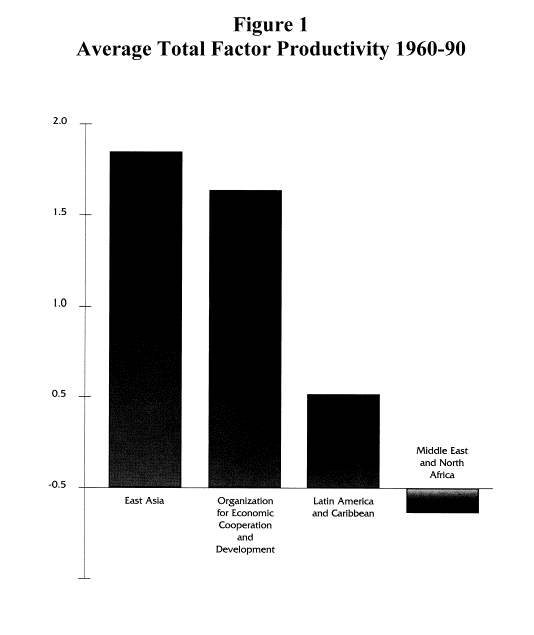
Since the 1960s, arab countries have lagged badly behind most other nations, except african nations. The Strategy Page recently offered a few comments on this issue:

Since World War II, the Arab world has lagged the rest of the planet in economic growth. For example, 300 million Arabs, and all that oil, generate less economic activity than Spain, and its population of 40 million. The main problem has been bad government. Too many dictators, and too much government restrictions on the economy. Too much corruption and waste. Even higher oil prices don't help, as it simply provides more money to be wasted on consumption, rather than business investment.

One of the things that has been changed in Iraq is the way the economy is regulated. Since Saddam was tossed out in 2003, the economy has been governed by Western rules. As a result, GDP per capita doubled by the end of 2005, and the GDP is expected to grow another 49 percent by 2008. All this despite continued attacks by Sunni Arab rebels on oil facilities and other economic targets. It's much easier to start a business in Iraq now, even though there's still a lot of corruption. The big change is that now the corruption is illegal, and there is even progress in prosecuting the government officials who take bribes or try to shake down businessmen. Lebanon is the only other Arab state to run its economy in a Western fashion, and they have thrived. However, Lebanon also interrupted their success story with a fifteen year (1975-90) civil war. Iraqis are well aware of that, and have no illusions about what happens if everyone does not get along. Another thing haunting Iraqis is the most successful economy in the region; Israel. This is also the country most like the economically successful Western states. Iraqis can't really talk about it openly, but the "Israeli Model" is discussed.


In spite of all that oil, something is holding arabs down, making them the laggards of the modern world. Humble little Spain is more an economic powerhouse than all the arabs. What is wrong with all of them?
Arabs are not adding value to their children--there is no added "human capital" in arab societies. Arabs have to import their professionals, engineers, and technicians. Measures of years of schooling in arab countries are pathetic, but do not accurately reflect the huge tragedy, since much of the schooling that does exist is counter-productive schooling in arab supremacy, religious fanaticism, and ethnic hatred. If arabs did not have dreams of bloody conquest of infidel lands, they would have only dreams of stolen glory.

When the oil does run out, the western infidel world will use other fuels besides arab oil. What do the arabs propose to do for economic output then? It seems that their oil only postponed the day of reckoning.

Friday, April 07, 2006

Idiots to the Left, Morons to the Right, Here I Am--Stuck in the Middle


Here is an example: "begging the question." Begging the question is a common logical fallacy that fewer people recognise every year. In general, the phrase is misused at least 90% of the time, in popular journalism and media discourse. But if people do not know what "begging the question" means, how will they catch people doing it when they need to? And that is just the tip of the iceberg, since far more logical fallacies escape detection than are caught. And that is in the world of supposedly professional wordsmiths, journalists, and intellectuals.

The lowest common denominator is good enough for television writers and news producers. Why aim for an intelligent audience, when that would simply guarantee no audience at all? It is a matter of economics. If the schools produce morons, then businesspeople must orient their products so that they will appeal to morons and be usable by morons.

What is the cure? Increasingly, it seems that government schools are beyond repair. The schools of education where teachers are trained for government teaching, are populated by the excremental remnants of a dysfunctional university digestive system. The trend for the entire system--professors, teachers, students--is ever downward. It is a stagnant swamp of lobotomised political correctness, with no outlet. It is a swamp that cannot be drained, due to its carefully self-propagating design.

Bypassing the swamp is the only hope--for as many of the next generation as can be salvaged. If only the swamp ended at the government school campus boundaries. Unfortunately, much of the popular culture has been swamped by the same lowest common denominator/low expectations/ braindead monotony that typifies government schools and government employees.

Bypass the swamp, and work for better technologies and approaches to learning. The cure is helping the young learn how the world works, and how they can best fit themselves into the world, to have the most beneficial effect on both themselves and the world around them as possible.

Monday, March 27, 2006

Cognitive Sex and Gender Differnces

While the scientific findings that male and female brains are anatomically and functionally different, statistically, is still quite controversial on a political level, on a purely scientific level it is becoming well established. Doreen Kimura is one of several prolific women cognitive scientists who are brave enough to buck the political storm in order to pursue scientific truth. Camilla Benbow is another.

In this article published in Sexualities, Evolution and Gender, Kimura plainly lays out the basic argument and evidence.

Many reliable anatomical brain differences have been found to differentiate men and women, from basic structures such as the hypothalamus, to differences in systems connecting the two hemispheres, such as the anterior commissure. Some of these have been reviewed in my book......We don’t yet know the significance of such differences for cognitive function, but to describe them as fiction is to deny the careful investigations of many respected scientists (e.g., Allen and Gorski 1990, 1991; Allen, Hines, Shryne and Gorski 1989; Allen, Richey, Chai and Gorski 1991). Although we now have a fair understanding of how brain systems work in mediating certain cognitive functions such as memory, language, and the like, we are still far from understanding how individual differences, the variation in such functions from one type of person to another, are mediated by the brain. However, it must follow that if two groups (such as males and females, left-handers and right-handers, or masculine and feminine gender types) differ reliably in some behaviour not simply dependent on physical differences, then their nervous systems must also differ in some way. Where else could the behavioural differences reside? This is just as true of learned as of unlearned behaviours. Brain differences underlying cognitive differences need not, however, be visible in simple structural features. They may take the form of differing organizational mechanisms not apparent by simply viewing the external brain.

This Scientific American article by Kimura presents the argument more methodically, and at greater length.

Men and women differ not only in their physical attributes and reproductive function but also in many other characteristics, including the way they solve intellectual problems. For the past few decades, it has been ideologically fashionable to insist that these behavioral differences are minimal and are the consequence of variations in experience during development before and after adolescence. Evidence accumulated more recently, however, suggests that the effects of sex hormones on brain organization occur so early in life that from the start the environment is acting on differently wired brains in boys and girls. Such effects make evaluating the role of experience, independent of physiological predisposition, a difficult if not dubious task. The biological bases of sex differences in brain and behavior have become much better known through increasing numbers of behavioral, neurological and endocrinological studies.

Read the entire article here, it is quite fascinating.

This is a brief list of scholarly research supporting the concept of "innate differences" in neuroanatomy and cognition in males and females. It is a very abbreviated list, but it serves to introduce the evidence. For a much longer list, consult this reference list from one of Kimura's articles. Scroll down to the list, and continue scrolling. There are 111 citations, and that list is far from complete.

I have posted on this topic before--here, here, and here.

The research continues, and the weight of research--new and old--points to significant cognitive sex differences, or if you prefer, gender differences or gender disparities.

Politically, this is not a popular topic, and politically inclined "scientists" will more easily cling to the political line. It is difficult to get funding for this type of research, and publishing in some mainstream journals is difficult. Even university presidents can fall from grace if they forget the politically correct stance, and deviate from it. This has not discouraged the very persistent women and men of cognitive science.

Neither men nor women are superior to the other as groups. Both groups have statistical strengths and weaknesses. A wise society will seek to understand its members, rather than try to sweep under the rug any scientific findings that are inconvenient to a dominant political viewpoint.

Addendum: This Guardian article by Simon Baron-Cohen contains a link to a test you can take to determine if you have a male brain or a female brain. Just looking at your genitalia or your chromosome map will not tell you that. Regardless of your chromosomes, your brain has a mind of its own, perhaps of a different gender than your body. Are you willing to find out?

Gender Difference: The Gap that Will Not Close

At the elite levels of sports and athletics, the gender gap is prominent and resists closure. There is an approximate 15 minutes difference in the best times of elite male marathoners, and elite female marathoners. Other sports show similar differences at the elite level.

Remember when it was predicted that intensive training for women in athletics would close the gender gap in performance? Some years ago, when the marathon was first becoming a competitive event for women, the rapid improvement in female times led some to predict that female performances would soon equal those of men in the marathon. This has not happened, and it won't. The current world record for women is 2:21, compared to 2:06:50 for the men, a difference in speed of about 10%. This same 10% gap is present across the distance running performance spectrum The reason for the performance gap is not that women don't train as hard as men. There are some important physiological differences between the sexes that can't be overlooked or overcome.

....The "typical" young untrained male will have an absolute VO2 max of 3.5 liters/min, while the typical same-age female will be about 2 liters/min. This is a 43% difference! Where does it come from? Well first, much of the difference is due to the fact that males are bigger, on average, than females. Us humans are all (sort of) geometrically similar, so heart size scales in proportion to lean body size . If we divide VO2 by bodyweight, the difference is diminished (45 ml/min/kg vs 38 ml/min/kg) to 15 to 20%, but not eliminated.

....It is important to make note of the fact that these differences are "on average". In reality, there are many women with significantly higher VO2max values than average men. However, if we look at the "best of the best", the differences persist. Using XC skiing as an example from here in Norway, the highest reliable values for VO2 max recorded in national team XC skiers are about 90 ml/min/kg. The very best Norwegian woman has been measured at 77 ml/min/kg, a 17% difference. So, while this woman will outperform 99.9% of all men, she will not out-perform the national team level males.


Read more here.

A number of studies have demonstrated that boys inherit a performance advantage in athletics, for both pre-puberty, and even more so in post-puberty.
The stopwatch does not lie, and whether in swimming, running, weightlifting, shot put, bicycling etc. the superior VO2 max and muscle mass of males prevents the gender gap in athletics from closing. The only way to narrow the gap is to train the elite athlete girls and confine the elite athlete boys in restraints to encourage muscle atrophy and loss of VO2 max.

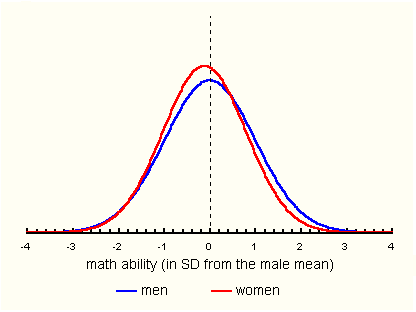
In the cognitive realm, you see a similar phenomenon in the measures of spatial ability and mathematical ability at the elite levels. Although hope springs eternal that training will narrow the gap, as in athletics, sometimes it seems that the only way to narrow the gap is to train the elite girls and prevent the elite boys from training somehow.

One can be excused for wondering why all the excitement about male superiority in a small area of elite cognitive performance? The number of jobs involved is minimal. Certainly an intelligent businesswoman, female physician, or female lawyer, can make much more money than an elite mathematician, physicist, or engineer. What is all the near-hysteria about?

Average intelligence levels of men and women test virtually identical. A 1995 study examined the performance of more than 100,000 American adolescents on various mental tests. The study found that on average, females performed slightly better than males on tests of reading comprehension, writing, perceptual speed, and certain memory tasks. Males tended to perform slightly better than girls on tests of mathematics, science, and social studies. In almost all cases, the average sex differences were small.

And here is how developmental psychologist David C. Geary puts it:

There was no sex difference on the IQ test, but males showed significantly higher mean scores on the arithmetical computations, arithmetical reasoning, and spatial cognition measures. A series of structural equation models indicated that individual differences in arithmetical reasoning were related to individual differences in IQ, spatial abilities, and computational fluency. Moreover, the results suggested that the male advantage in arithmetical reasoning is mediated by the male advantages in both computational fluency and spatial cognition.

Women are graduating from schools of higher education at a rate of 6 to 4 vs. men. Women have achieved virtual parity in schools of medicine and law, and make up about 70% of graduate psychologists. Women are achieving phenomenally in the modern world, and if any gender should be worried about current trends, it is the males. A few men are holding on under siege, to a small sliver of cognitive excellence, and all that many psychologists can think of doing is to try to eliminate the small gap within that tiny sliver of cognitive performance.

It is a fascinating study in academic frustration--the data will simply not behave in a politically correct fashion. Many more research studies and outreach programs will be mandated, however, to erase that gap. But I can tell the gender psy-sers exactly how to erase the gap, and I will not charge for the valuable information. Simply prescribe pro-androgenic drugs that cross the placental barrier, to pregnant women in their second trimester, who are carrying female fetuses. Some additional androgenic supplementation may be necessary at different time periods after birth--and there will be potentially unpleasant side effects. Hirsutism, deep voice, skin blemishes, a certain manly aggressiveness, etc. But all of that would be a small price to pay to erase the gender gap in this one small remaining area of academics, no?

Just as there are elite women athletes who can defeat 99% of males in their sport, there are women mathematicians and physicists who are better at their trade than 99% of males. But they are not competing against those 99%. They are competing against the elite males, a very small number, but a significantly greater number than the number of elite females in those vocations. That is the hump that the gender Procrusteans are incapable of leveling. The relatively tiny number of male elites in a relatively tiny number of fields who will simply not go away.

Lawrence Summers paidwith his job, for making a very timid suggestion about possible biological gender or sex differences in that very small, elite sliver of academic professorship in a few top rank schools. The politics of this subject are absolutely deadly to anyone in a public position who lets down his guard for even a moment.

But why? I will deal with the real reasons for the excitement in a later posting.
DNA Surprises: Genetic Research in High Gear

Thanks to Snowcrash for pointing to this CIT newsrelease that details new discoveries in "gene interaction."

The difficulty lies in the fact that two genes can pair up in a gigantic number of ways. If an organism has a genome of 20,000 genes, for example, the total number of pairwise combinations is a staggering total of 200 million possible interactions.

Researchers can indeed perform experiments to see what happens when the two genes interact, but 200 million is an enormous number of experiments, says Weiwei Zhong, a postdoctoral scholar at the California Institute of Technology. "The question is whether we can prioritize which experiments we should do in order to save a lot of time."

....a genetic-interaction network provides a faster and better way at determining how certain genes interact. Such a network also provides information about whether anyone has ever done an experiment to determine the interaction of two particular genes in one of several species.

"This process works like a matchmaking service for the genes," says Zhong. "It provides you with candidate matches that most likely will be interacting genes, based upon a number of specified features."

The benefit, she adds, is that biologists do not need to do a huge number of random experiments to verify if two genes indeed interact. Therefore, instead of the experimenter having to run 20,000 experiments to see if two genes randomly chosen from the genome of a 20,000-gene organism interact, they might get by with 10 to 50 experiments.

"The beneft is that you can be through in a month instead of years," says Sternberg
Read the entire report here. Hat tip Biosingularity Blog.

The next story deals with advances in developing transgenic plants--getting plants to make proteins from other species--in this instance getting tobacco plants to make human albumin. This is from a Bio.com newsrelease:

Agricultural engineer, Alicia Fernández San Millán, has developed a novel technique in Spain - plastidial transformation, in order to produce, in a recombinant form, human albumin from tobacco plants. According to her PhD thesis, plastidial transformation is an economically viable alternative, as it enables increasing the levels of HSA by between 10 and a 100 times, compared to levels obtained by nuclear transformation. Read the entire newfeature for more information.

The following story deals with "junk DNA", the 98% of all human DNA that does not code for protein. Buried within the junk DNA is hidden treasure--epigenetic control sequences that influence the gene expression of the 2% of coding DNA.

The notion that mutations in enhancers play a role in human disease progression has been difficult to confirm because usually enhancers are located in the 98 percent of the human genome that does not code for protein, termed non-coding DNA. Unlike DNA sequences that code for protein, non-coding DNA, sometimes referred to as "junk" DNA, follows few rules for organization and sequence patterns and therefore is more difficult to study.

"The difficulty with human genetic approaches to common disease is that we lack the power to precisely localize DNA sequences that are associated with disease, often leaving us immense stretches of DNA to look at," says one of the study's corresponding authors, Andy McCallion, Ph.D., an assistant professor in the McKusick-Nathans Institute. Most often one is limited to looking in the most obvious places, which may not yield the best results. "Until now," he says, "we've only been able to look under the lamplights for the car keys."

....The system is a significant advance over current methods in this model species, allowing researchers to study more sequences in a shorter period of time.
Read the entire news report here.

This report discusses a discovery of a gene variant--always think "hapmap" when hearing the term "gene variant"--that affects the onset of cancer.

Normally our genes have to be divided into two perfectly identical copies when a cell divides. The unfortunate variant causes a defect in the division of the genetic material (mitosis), which means that a daughter cell may get too few or too many genes.

If a daughter cell does not receive a gene that prevents cancer, a so-called tumour suppressor gene, then a cancer can grow. One defence mechanism against cancer is for a cell that gets faulty genes to commit suicide (apoptosis).

The defect caused by the unfortunate variant when it divides the genes is so tiny that the suicide mechanism does not detect the fault, which allows the cell to continue its growth into a cancer.
Read the rest here.

Finally, here is a glimpse into the distant past, toward the possible origin of life on earth. This Eurekalert newsrelease discusses experiments attempting to delve into possible origins of the DNA-RNA encoding system that supports all known life.

This "evolutionary conversion" provides a modern-day snapshot of how life as we understand it may have first evolved out of the earliest primordial mix of RNA-like molecules-sometimes referred to as the "pre-RNA world"-into a more complex form of RNA-based life (or the "RNA world") and eventually to cellular life based on DNA and proteins. Nucleic acids are large complex molecules that store and convey genetic information, but can also function as enzymes.

While the transfer of sequence information between two different classes of nucleic acid-like molecules-between RNA and DNA, for example-is straightforward because it relies on the one-to-one correspondence of the double helix pairing, transferring catalytic function is significantly more difficult because function cannot be conveyed sequentially. The present study demonstrates that the "evolutionary conversion" of an RNA enzyme to a DNA enzyme with the same function is possible, however, through the acquisition of a few critical mutations.

The study was released in an advance online version of the journal Chemistry & Biology.
Read more here.

This posting covers only a small cross section of ongoing genetic research. Al Fin has covered several of these topics previously. All of those past postings are available via the archives on the sidebar. Most people would feel overwhelmed if they had attempted to look deeply into any of these reports. No one is expected to know everything about everything, after all.

Saturday, March 25, 2006

How to Search This Blog


Often, a google search will land you at a website such as this for no apparent reason. Your search terms apparently have nothing to do with the current postings. Do not give up yet. First, use the blogger search tool at the top of the page. Place your search terms in the window, and click on "search this blog." Then if there are any postings anywhere on this blog that match your search terms, they will be displayed on the search results page.

If the webpage has an added google search bar, you can also do a google website search, which is very much like a blogger website search, if not identical.

Friday, March 17, 2006

Memory Theory from Develintel

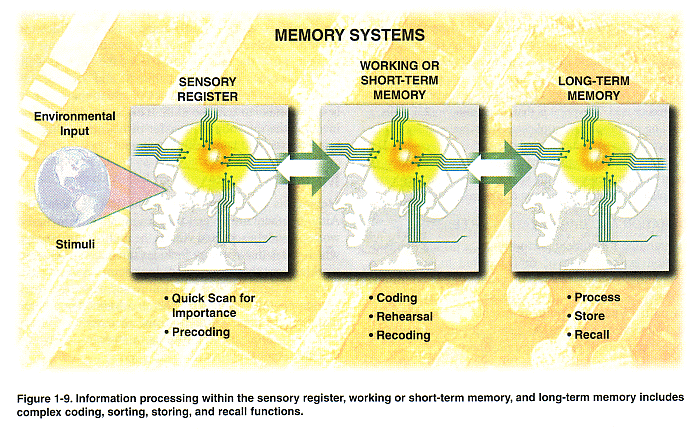
Chris Chatham of Developing Intelligence Blog has a dynamite posting today on "Visualizing Working Memory." Chris finds that the conventional view of human memory as pictured above, is deficient in several ways, that he details in his post.

Although hugely influential, the model has a few unfortunate shortcomings.

Most importantly, memory is not a static process. Memory decays unless it follows the cycle of learning, encoding, recall, and recoding. In contrast, the classic "modal" model distinguishes storage functions from processing functions - i.e., one is a "black box" and one is a "black arrow." Unfortunately, this distinction is artificial, because the brain contains only arrows: processing (activation) and memory (synaptic efficacy) are two sides of the same coin, and memory itself is a process.

Second, all arrows are not created equal. "Architectural" differences (such as the synaptic efficacy of recurrent connections) among different parts of the brain lead to different processing profiles. These profiles can differ in terms of bandwidth, or in other words, how much information they are capable of holding at a time. Orthogonal to bandwidth, these profiles can also differ in terms of decay rate (or alternately, vulnerability to interference): that is, some regions are capable of maintaining information indefinitely while others are capable of maintaining memories for less than one second.

Third, multiple processing paths require gating functions. Perhaps the largest advantage of removing the "boxes" from the traditional "box and arrow" diagram is that one must become explicit about the functions performed at every step. As a result, such diagrams will be more likely to provide a nice one-to-one relationship between cognitive functions and neuroanatomy. And pure-arrow diagrams remove the need for some elusive "executive functioning" box to coordinate and configure the processes; instead, one need only posit a gating function at the intersection of every arrow with another, in which some process allows information to pass along from one arrow to the next (probably based on dopamine fluctuations).


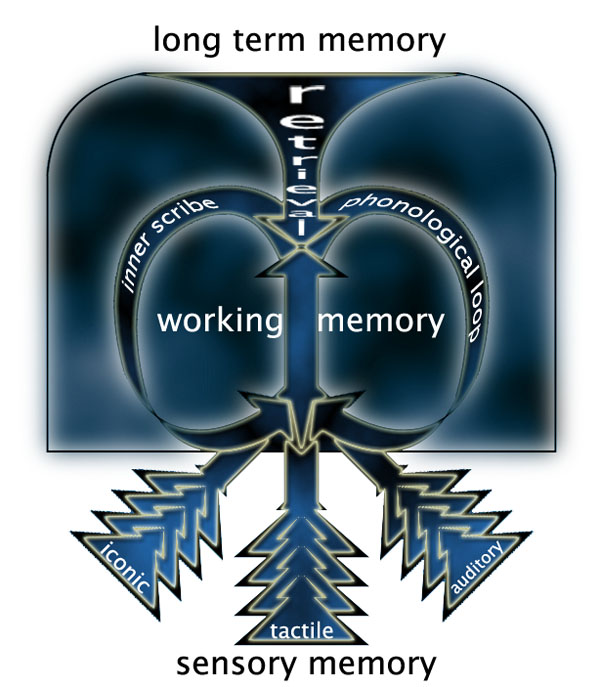
Then Chris describes his own developing model of memory, which is pictured below and to the left. He has drawn his own model to better reflect the physiological realities of memory as he has discovered them to be.
Sensory Memory. As you can see from the image ...., incoming sensory information has an extremely high initial bandwidth, and a rapid rate of decay, as indicated by the fat, short arrows. Furthermore, there is no rehearsal process, and sensory memory is constantly overwriting itself. This is indicated visually by the multiple arrows which overlap, and quickly diminish in width.

Working Memory. This process slowly transitions into a relatively low-capacity - and low-decay - polymodal short-term/working memory process, as indicated by the smaller width of the arrows in the middle of the diagram. Importantly, the width of this arrow does not shrink over time, indicating that the rate of decay is extremely low; indeed, we can hold somewhere between 4 and 7 items in working memory (depending on modality) without decay.

This short-term/working memory process feeds two unique rehearsal processes, each of which is relatively robust to decay yet limited in bandwidth: an articulatory rehearsal process, as well as an "inner scribe" which supports imagery functions (such as mental rotation). These rehearsal processes essentially "refresh" short-term/working memory with previous information, allowing it to be maintained over time.

Long Term Memory. Finally, the entire diagram rests above the base of one massive arrow that folds back on itself: this represents long-term memory. Long-term memory has an essentially unlimited capacity, as indicated by this arrow's enormous base width, but is subject to decay and interference over time. Items can be retrieved from long-term memory, at which point a "gating function" permits us to actively think about the past (i.e., rehearse it), or to merely let it recur and disappear again from our "mind's eye."


Read the entire article here.

I am not surprised that Chris has referred to work from Gerald Edelman's lab in previous posts. This model reminds me of some of Edelman's concepts of memory, as described by Rosenfeld in The Invention of Memory. Chris has some very impressive postings on his blog. Be sure to look through them.

Monday, March 06, 2006

For a Neuron, Too Much Excitement Can Kill


We know that much of the damage from strokes comes from an overload of glutamate, an excitatory neurotransmitter. Neurodegenerative changes in Alzheimer's Disease is probably also due to glutamate overexcitation, at least in part. Now scientists are beginning to tease apart the mechanism of excitative neurotoxicity. This news release give more information:

For neurons, overexcitement is deadly. To avoid this, brain cells must sop up unneeded neurotransmitters from the synapse through membrane-bound transporters. If these transporters fail, neurons and other brain cells get excited to death-- a phenomenon that may contribute to brain damage during stroke and Alzheimer's disease.

Indeed, brain deterioration after stroke is associated with elevated levels of glutamate -- the major excitatory neurotransmitter in the mammalian central nervous system (CNS) -- in the plasma and cerebral spinal fluid. One possible explanation for this glutamate build-up, reported online on March 6th in The Journal of Experimental Medicine, is a mutation in the gene encoding the glutamate transporter protein EAAT2.

This mutation --- a single nucleotide change in the promoter region of the EAAT2 gene -- was equally prevalent in healthy individuals and stroke patients. But among stroke patients, those with the mutated allele had higher plasma levels of glutamate and were more likely to suffer from post-stroke neurological problems than those with the normal allele.

The mutation changed a binding site for the activating transcription factor AP-2 into a binding site for the repressor GCF2 -- a swap that inhibited promoter activity in transfected rat brain cells. Whether the mutant promoter decreases EAAT2 expression in the human brain, as would be predicted, remains to be tested.


Little by little, gene by gene, protein by protein, science is learning why humans suffer the way they do. And little by little science is finding ways to do something about it.

New Research Brings Artificial Organs Closer to Reality

Tissue engineering has long been in need of biological "fill material." Blood vessels, nerves, and other small structures lie in a "matrix" of tissue that supports it and facilitates necessary growth of biological structures. A recent news report details the creation of a new type of "bio-gel" that may suit the need.

Scientists at The University of Manchester have created a new type of 'bio-gel' which provides a pH neutral environment for culturing cells in 3D, as published in the journal Advanced Materials (March 2006).

The gel is the first pH neutral material made from combinations of dipeptides (pairs of amino acids) to provide an environment in which cells can be cultured under physiological conditions.

Uniquely, the gel mimics the properties of cell scaffolds which naturally occur in the body and has potential applications for wound healing and tissue engineering.

Cell scaffolds, known as the extra cellular matrix (ECM), are naturally produced by the body to grow new cells in order to repair damaged tissue. Like the ECM, the gel acts like a scaffold in which cells can grow.

In their paper, 'Nanostructured Hydrogels for Three-Dimensional Cell Culture Through Self-Assembly of Fluorenylmethoxycarbonyl-Dipeptides', Dr Rein Ulijn and collaborators describe how the gel is created through a process of self-assembly.

Dr Ulijn said: "We have used combinations of modified dipeptides which act like building blocks and spontaneously assemble into nanometer sized fibres when exposed to physiological conditions, to create a fibrous gel-like structure in which cells can be cultured. Because this material is made up of 99% water and is pH neutral, it is compatible with biological systems.

"By using dipeptide building blocks instead of much larger oligo-peptides used by other researchers, we have greater control over the fibrous architecture and the physical properties of the gels. These materials offer us great potential for future applications in wound healing and regenerative medicine."

Dr Ulijn and his collaborators have successfully cultured cartilage cells using the gel. They found that both the properties of the gels formed and the cell response to the gels could be controlled by using different combinations of di-peptides. The team recently received a £630k award from EPSRC to develop the gels further.


This is good news for tissue engineers, and forward thinking plastic surgeons. With improvements in collagen synthesis, cartilage production, and other basic level tissue engineering processes, the creation of functioning lab-grown organs, complete with support tissue, is much closer.